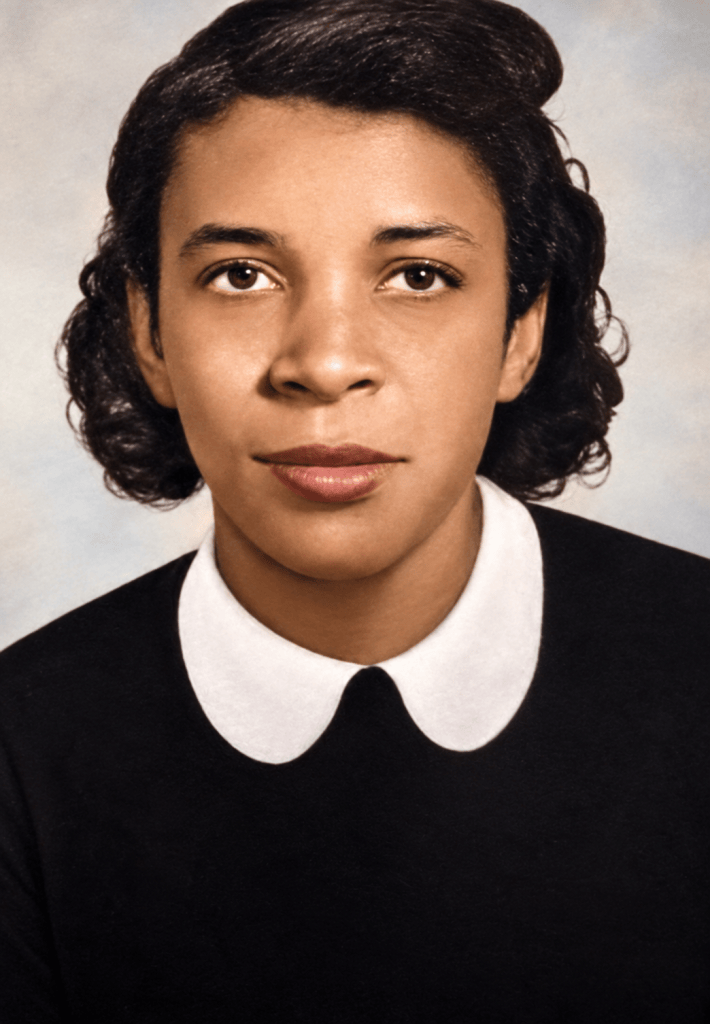
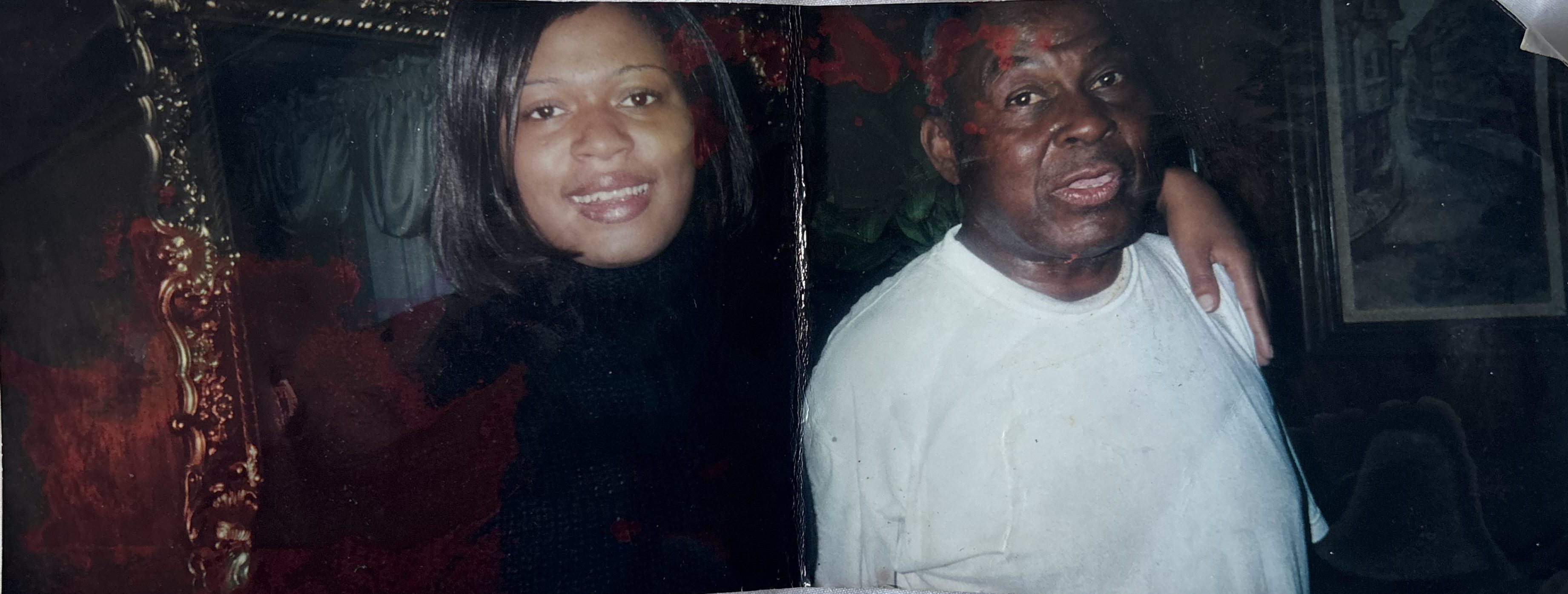
For my Photo Retouching assignment, I chose photographs of my aunt and grandfather because these images have personal and family significance to me. Restoring them made the assignment feel more meaningful because I was not simply practicing Photoshop techniques; I was helping preserve important family memories.
In Photoshop, I worked carefully to repair damaged and distracting areas while maintaining the original character of each photograph. I used retouching tools to clean up imperfections, restore areas of the images, and improve the overall visual quality. I also paid attention to details such as tone, contrast, and clarity so the restored photographs would look cleaner without appearing overly edited. One of my biggest challenges was deciding how much restoration was necessary while still keeping the photographs authentic.
This project helped me understand that photo retouching can be more than correcting an image. It can also be a way of preserving history, memories, and the people who are important to us. Working with photographs of my aunt and grandfather made me more patient with the editing process and motivated me to produce a restoration that I would be proud to include in my portfolio.
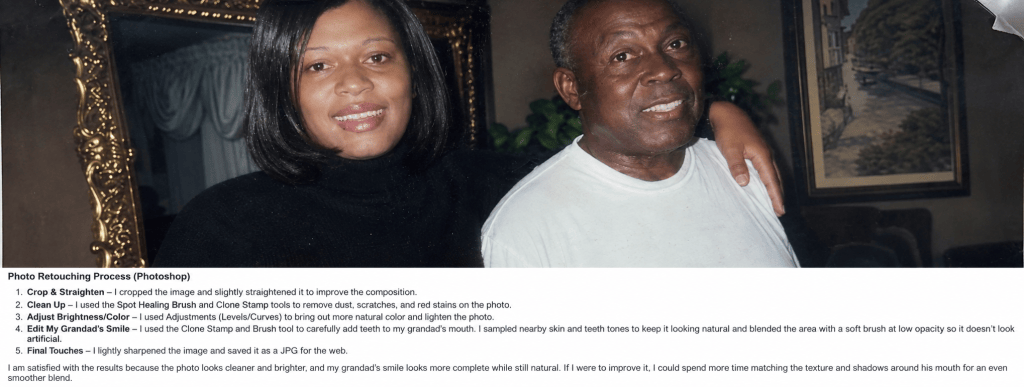
For this assignment, I chose old photographs of my aunt and grandfather because they are meaningful family memories that I wanted to restore and preserve. In Adobe Photoshop, I used the Spot Healing Brush and Healing Brush tools to remove scratches, marks, discoloration, and damaged areas while blending the corrections into the original photographs. I also used the Clone Stamp tool to copy undamaged areas over sections that needed more detailed repair, and I adjusted the brightness, contrast, and tones to make the faces and important details clearer. The most challenging part was repairing facial details while keeping my aunt and grandfather looking natural and not overly edited. I am satisfied with my results, but with more practice I could improve the smaller details, blending, and texture to make the restored areas match the original photographs even better.
The Name He Chose
My grandfather was not born with a name. He was born with initials. That was the custom for a lot of Black folks coming up out of slavery, a cruelty so ordinary nobody even had to explain it. You did not get a full name because a full name is a claim, it says here is a whole person with a history and a future, and the world he was born into was not ready to make that claim about him. So they called him JC and left it there, two letters standing in for a person, like his family expected him to fill in the rest himself one day.
And he did. When he joined the army, they told him he had to choose a name, an actual name, something a government could file and a paycheck could be written to. And out of everything he could have picked, he chose James Charles. I think about that decision more than almost anything else in my family’s story. A man handed the one chance most people never get, the chance to name himself from nothing, and he did not waste it on something small. He built himself a name that sounded like a man who intended to be remembered.
That is the whole story of legacy right there, if you ask me. Legacy is not what gets handed to you. Legacy is what you build when the world only gave you two letters and dared you to make something out of it.
James Charles went on to father thirteen children and own his own home, which in his time was its own kind of quiet rebellion, a Black man with land and a roof he answered to nobody for. But he did not get to keep his family whole the easy way. His wife, Netty Joe Wright, a homemaker who held that big household together, died when their youngest, Gladys, was only five months old. I sit with that a long time. A man who spent his whole life being told he was not entitled to permanence, losing the person who was supposed to be permanent with him, and still choosing to raise thirteen children into people who knew who they were. He gave them culture. Not just survival, culture. That is not a small thing to hand down when the whole system around you was built to make sure you had nothing to hand down at all.
Gladys, that baby who lost her mother at five months old, grew up to become a renowned author, a woman who put whole worlds into books that people are still reading. I think about the distance between those two facts, a child who arrived at the tail end of grief and became someone who built stories for a living, and I do not think that is a coincidence. I think that is what culture does when it is passed down right. It does not erase the hard parts. It teaches you what to build out of them.
I never got to ask my grandfather what it felt like to write “James Charles” down for the first time, to hand a piece of paper back to a government that had spent generations trying to make his people invisible and watch them have to type his chosen name into their records. But I know what it felt like to be his grandson. He was the first person who ever looked at me and called me an activist. Not somebody who was going to become one someday, not somebody with potential. He named it in me the same way he had named himself, like the naming was the thing that made it real. I carry that the way I imagine he carried James Charles, like something I chose to grow into rather than something I was simply given.
This is what nobody tells you about slavery and its aftermath when they teach it like it is only a chapter that closed. It did not just steal labor and time. It tried to steal the right to name yourself, to decide who you are before anybody else gets to decide it for you. Racism, in whatever form it takes across generations, is still fundamentally an argument about who gets to define a person. My grandfather answered that argument with his own two hands. He looked at a system that gave him initials and said no, I am James Charles, father of thirteen, husband to Netty Joe, homeowner, and I will decide what culture my children inherit.
So when I think about legacy and identity, I do not think about bloodlines or portraits on a wall. I think about a man who was handed nothing but the barest outline of a person and filled the whole thing in himself, then handed his children enough culture and enough love that one of them became an author and one of his grandsons became somebody who fights for people the way his grandfather once had to fight just to be called by his own name.
That is the inheritance. Not the trauma, though the trauma is real and I do not pretend it away. The inheritance is the choosing. He chose his name. He chose to build a family after losing the center of it. He chose to call a young activist into being just by saying the word out loud to him. I am still trying to be worthy of a name that good.
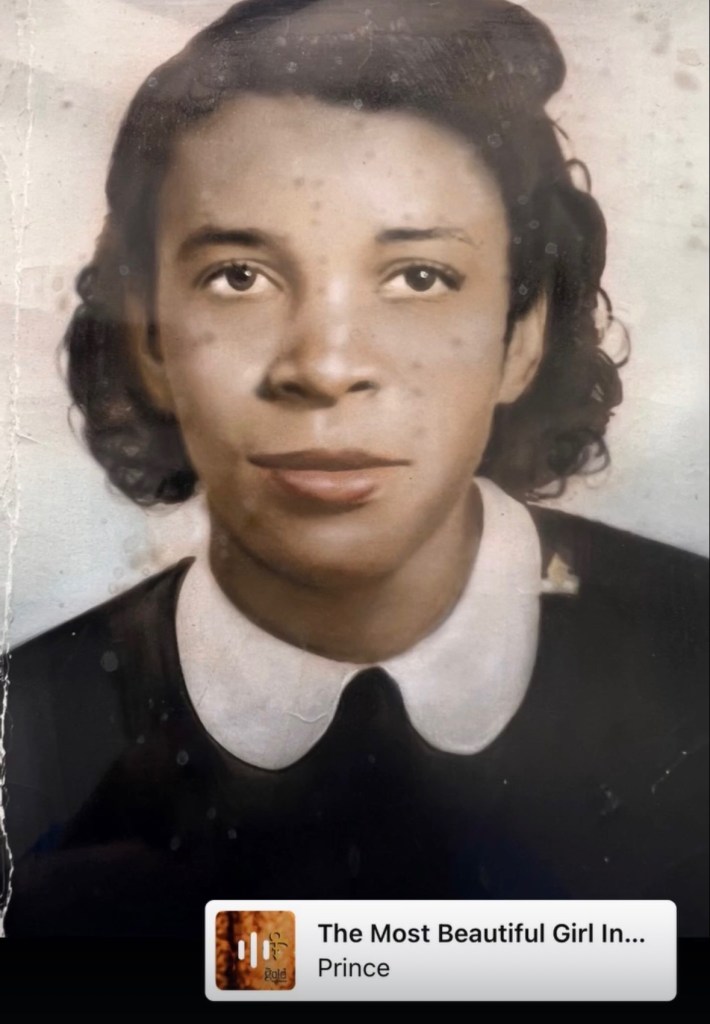
Retouching – Restoring My Grandmother, Netty Joe Wright
For my retouching assignment, I chose a photograph that means a lot more to me than just completing a class project. This is an old photograph of my grandmother, Netty Joe Wright, and I wanted to restore it while still preserving the beauty and history of the original image.
The photograph had scratches, cracks, discoloration, and other signs of age. In Adobe Photoshop, I used the Spot Healing Brush Tool and Healing Brush Tool to clean up smaller scratches and damaged areas. For some of the larger areas, I used the Clone Stamp Tool to copy details from undamaged parts of the photograph and carefully blend them into the damaged sections. I changed my brush size and opacity as I worked, especially around her face, hair, and clothing, because I did not want the corrections to look too strong or unnatural. I also adjusted the brightness, contrast, and color to make the photograph clearer while keeping the vintage feeling of the original.
I am satisfied with my results because I was able to bring new life to an important family photograph while still keeping my grandmother recognizable. My favorite part of the assignment was seeing the scratches and damage disappear little by little and watching the photograph become clearer. If I continued working on it, I would spend more time improving some of the smaller details and blending the repaired areas more smoothly. This assignment also showed me that photo restoration is not just about fixing an old picture—it can be a way of preserving family history and memories for future generations.