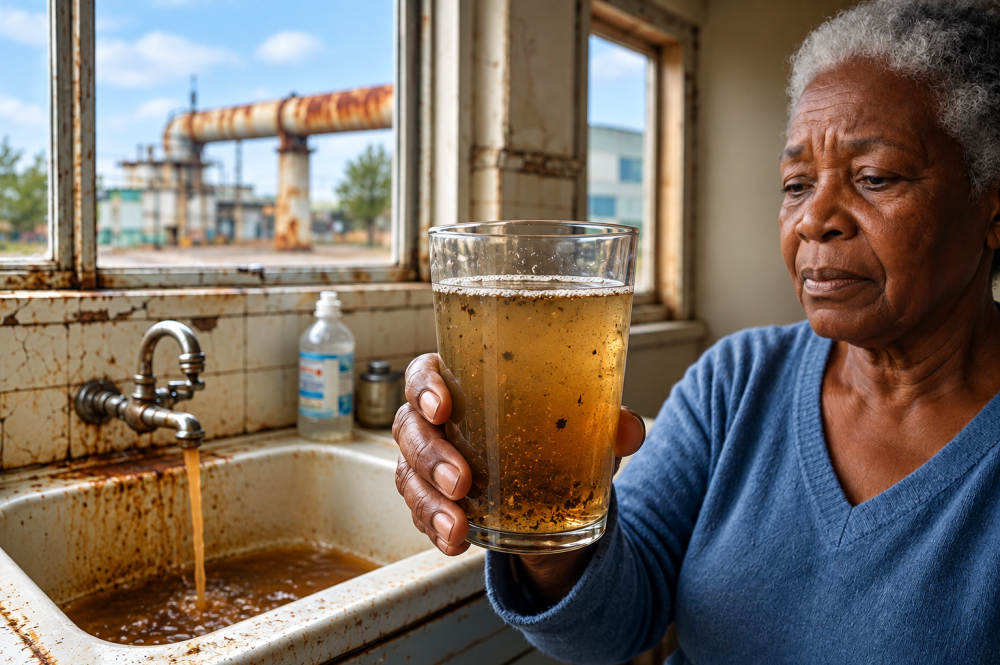
FINAL POSTER — ZERO HUNGER
Humanity. Technology. Compassion. A Shared Responsibility.
AI Can Help. Humanity Must Lead.
United Nations Sustainable Development Goal 2 | Digital Imaging ITECH 110 | Fall 2026
Created by Orion Wright | Zeekbrium Photography
Revised Final Composition — Incorporating Professor Moreaux’s Feedback
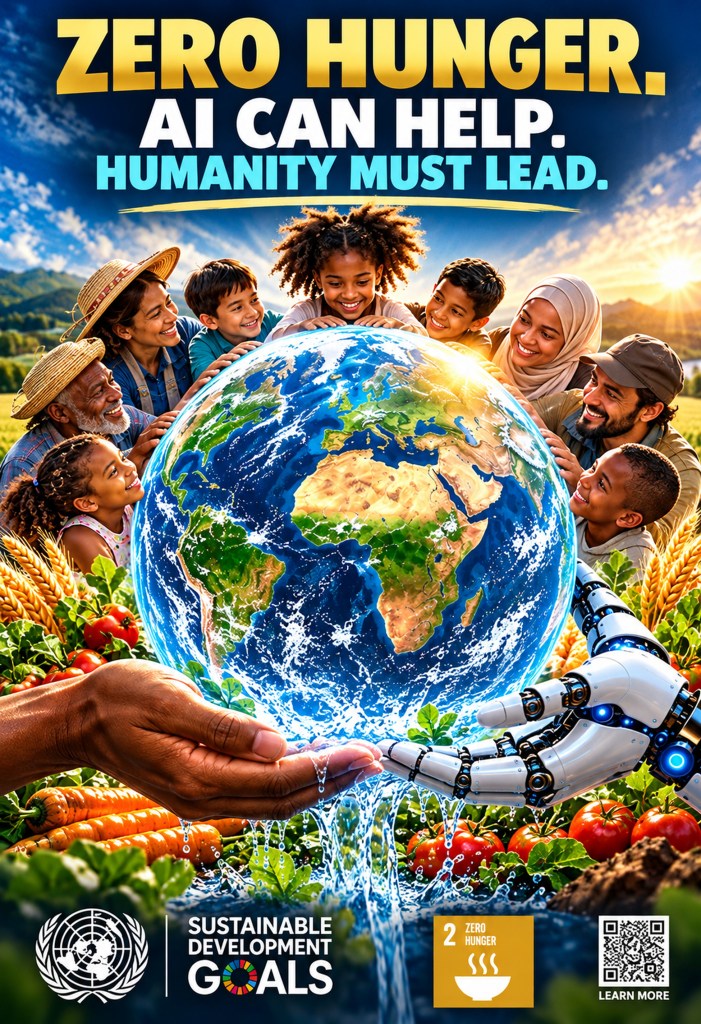
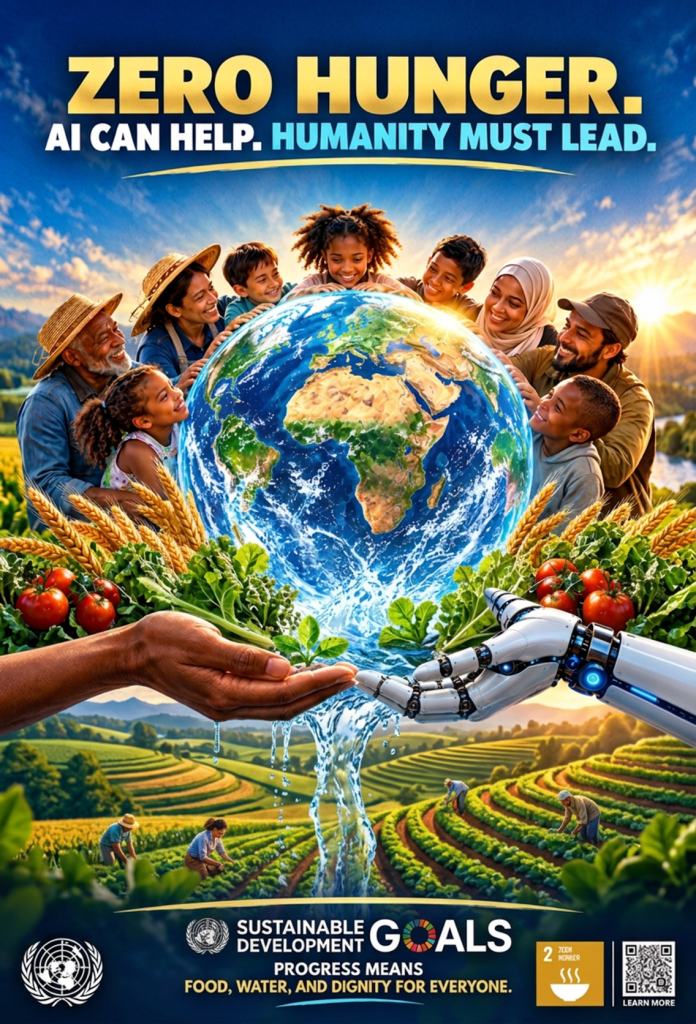
This is my final composition for my Zero Hunger campaign, “AI Can Help. Humanity Must Lead.” It is inspired by the belief that no human being should have to experience hunger or live without access to clean water in a world capable of extraordinary technological advancement. After receiving Professor Moreaux’s feedback, I strengthened the visual hierarchy by making the globe, surrounding communities, and two supporting hands the heart of the composition, allowing the imagery to communicate what words alone cannot. The human hand represents compassion, responsibility, and our moral obligation to one another, while the robotic hand symbolizes the possibilities of artificial intelligence when guided by human values. The surrounding children, families, agriculture, and flowing water represent our shared humanity and the essential resources every community deserves. I consider this composition complete because it brings together my message, imagery, typography, and color palette into one unified visual statement: technology may help us build a better world, but humanity must have the courage and compassion to lead it.
Extended artist’s statement — the heart behind the design
Behind the Vision: A World Where No One Is Forgotten
When I began developing my Zero Hunger campaign, I wanted to create something that would make people stop, look, and think beyond themselves. Hunger is not simply a statistic on a chart. It is a child trying to concentrate in school without having enough to eat. It is a parent making impossible decisions about which necessities their family can afford. It is a community surrounded by technological progress while still struggling to access the most basic resources needed to survive.
As someone who values photography and visual storytelling, I believe an image should do more than capture attention. It should awaken understanding, encourage compassion, and challenge the way we see the world.
The globe is the heart of my composition. It represents our interconnected existence and reminds viewers that hunger and water insecurity are not isolated problems. The people gathered around the Earth represent different generations, cultures, and communities united by a shared responsibility to protect human dignity.
The two hands carry the central message. The human hand symbolizes empathy, accountability, and our ability to care for one another. The robotic hand represents artificial intelligence and the opportunities it offers in agriculture, resource management, and technological innovation. Their shared support of the globe expresses my belief that innovation becomes meaningful when it serves humanity rather than replacing human judgment.
The crops and flowing water represent life itself. Food nourishes the body, water sustains communities, and both are essential to health, opportunity, and survival. I wanted these elements to feel abundant because my vision is not limited to showing what the world lacks. I also wanted to illustrate what becomes possible when people work together.
My choice of colors reinforces this message. Deep navy represents trust and responsibility, warm gold symbolizes hope, aqua reflects water and renewal, white creates clarity, and medium blue connects the composition to the Earth and our collective future.
Through this project, I have come to understand that effective visual communication does not require overwhelming the audience with information. Sometimes the most powerful message is the one people can feel before they read a single word.
AI can help us identify problems, discover solutions, and improve systems, but technology cannot replace our responsibility to recognize human suffering and respond with compassion.
My hope is that viewers walk away with more than admiration for the artwork. I want them to recognize that ending hunger is not only a technological challenge; it is a human responsibility.
Progress should never be measured only by how advanced our technology becomes, but also by how many lives we choose to uplift.
THREE HYPER-REALISM CONCEPTS — ZERO HUNGER CAMPAIGN
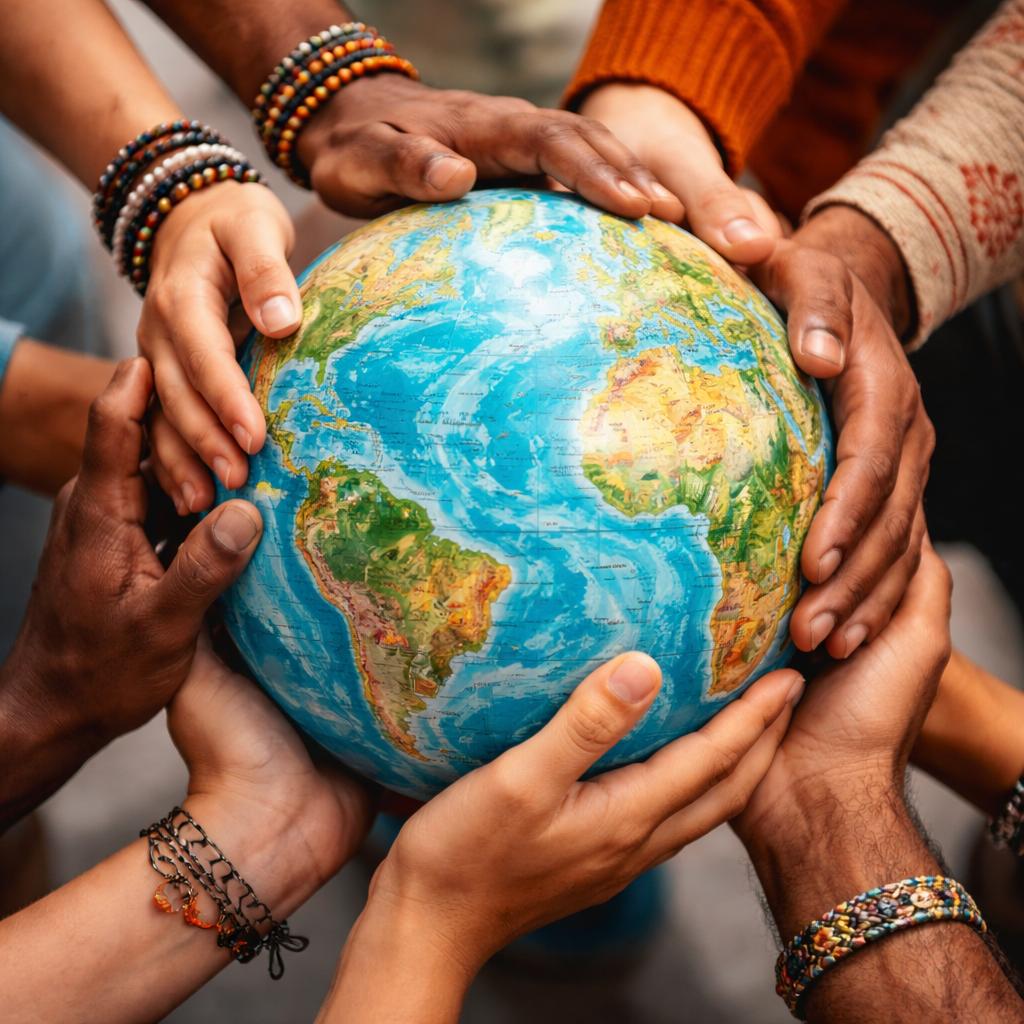
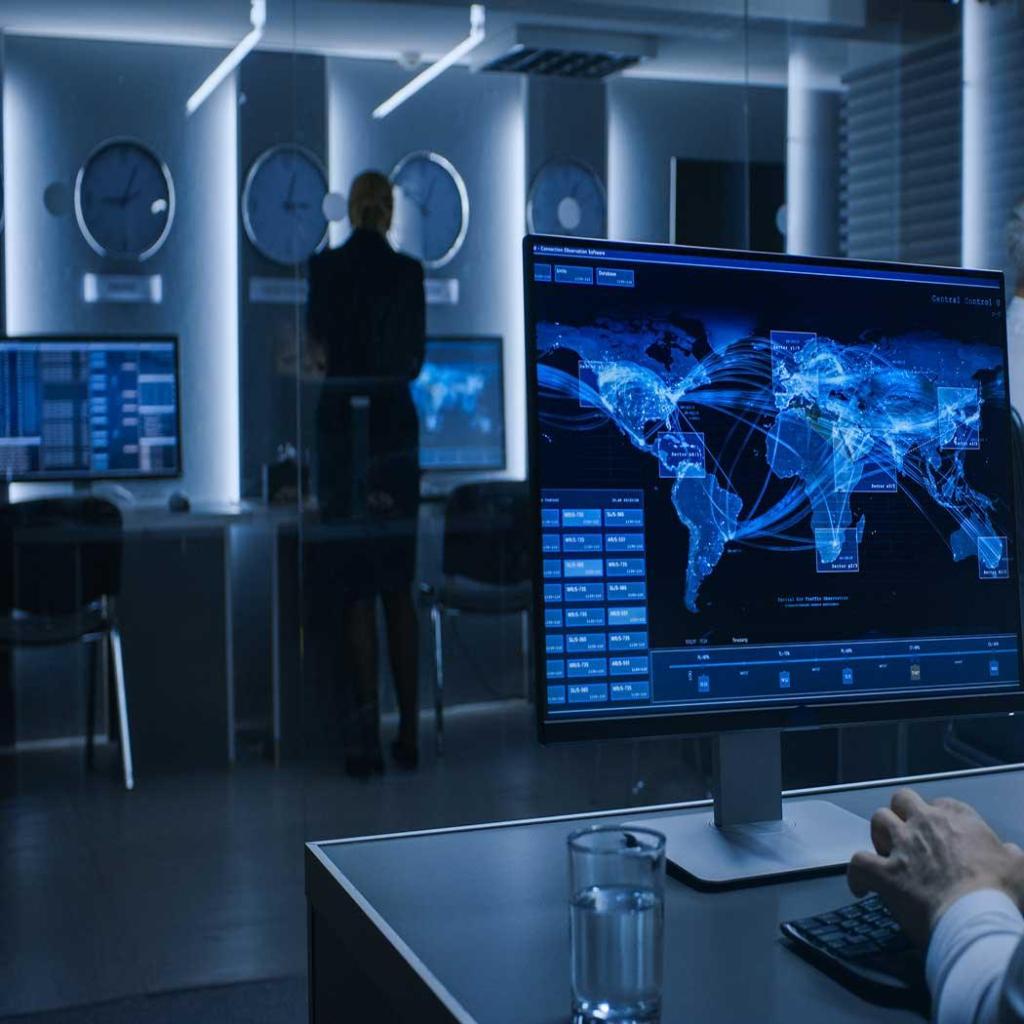
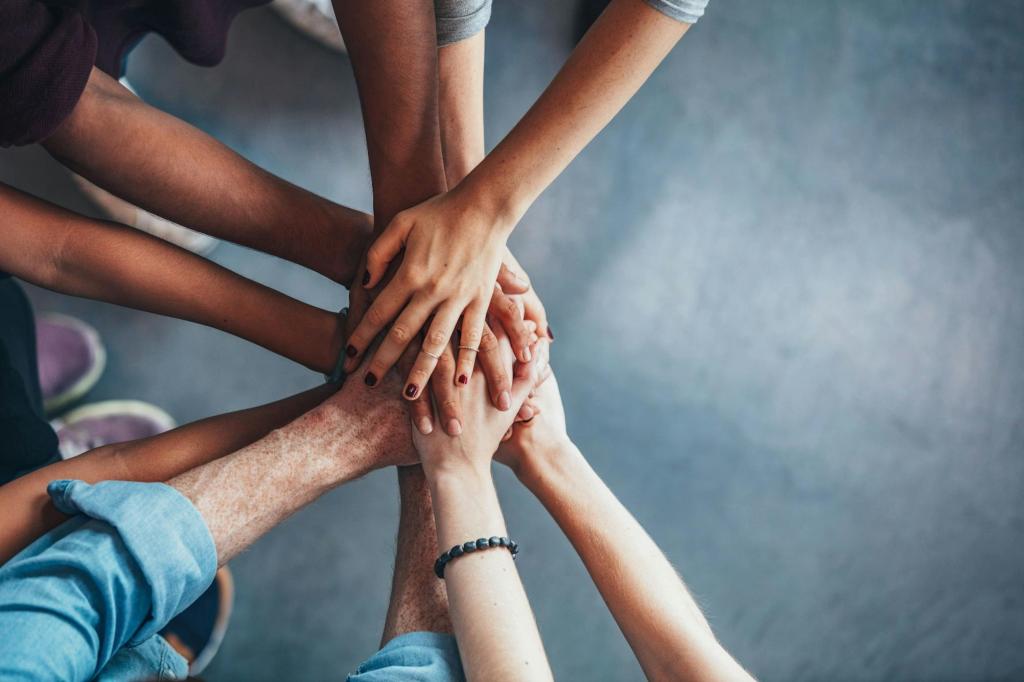
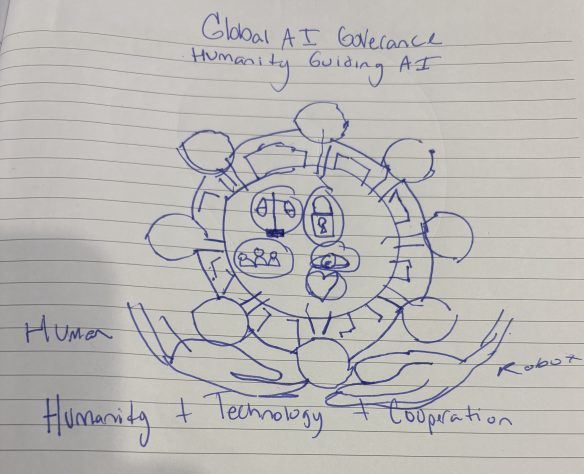
Concept #1 — Global AI Governance
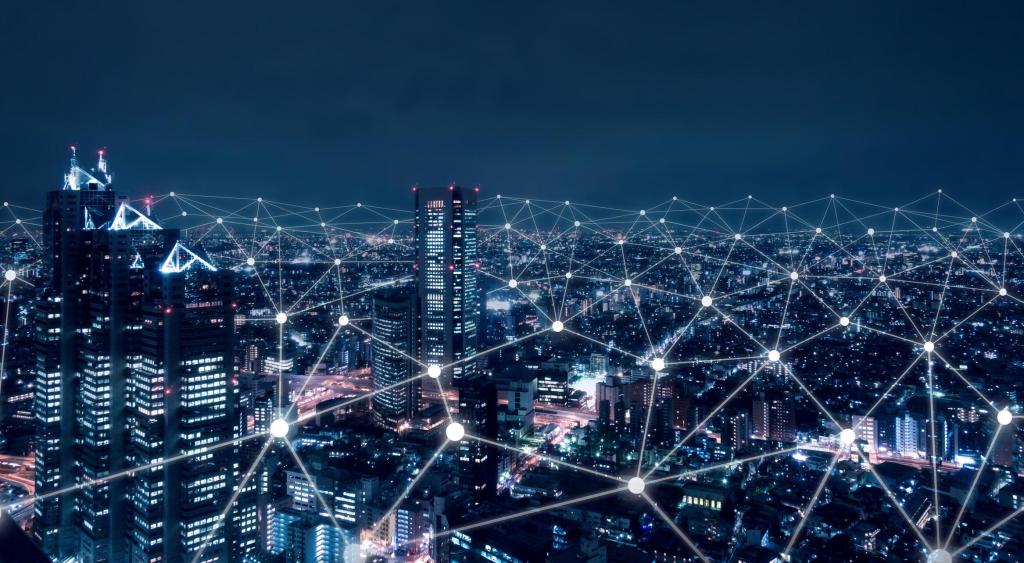
My original idea showed the world surrounded by people and symbols representing technology, security, ethics, and community. The hands supporting the design represented human responsibility for guiding technology.
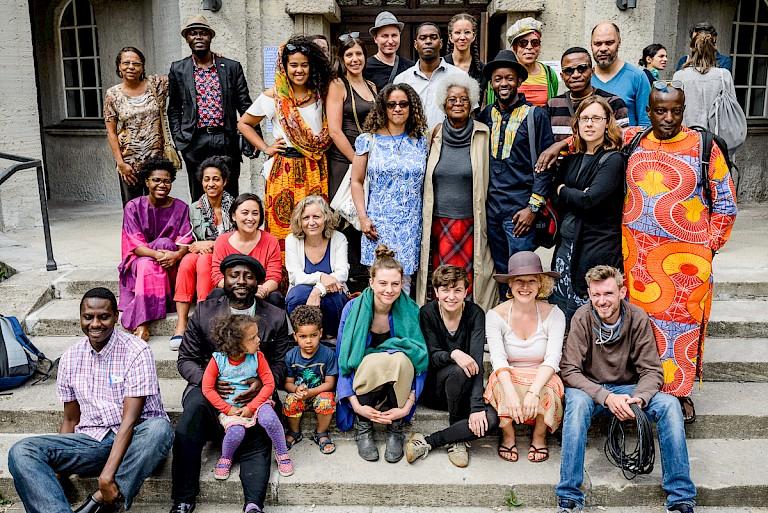
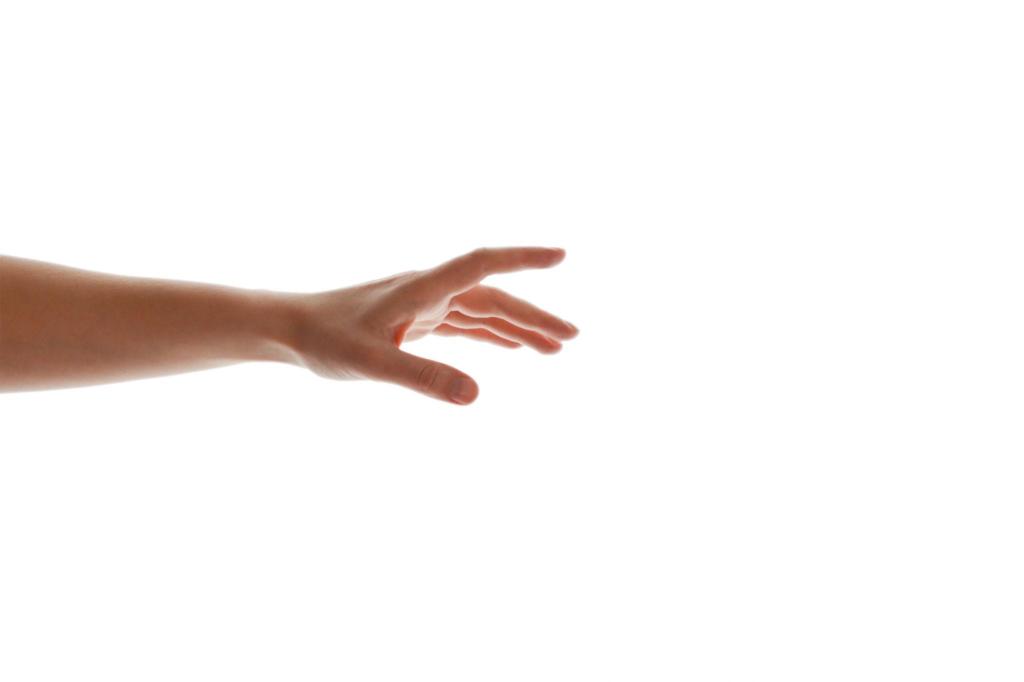
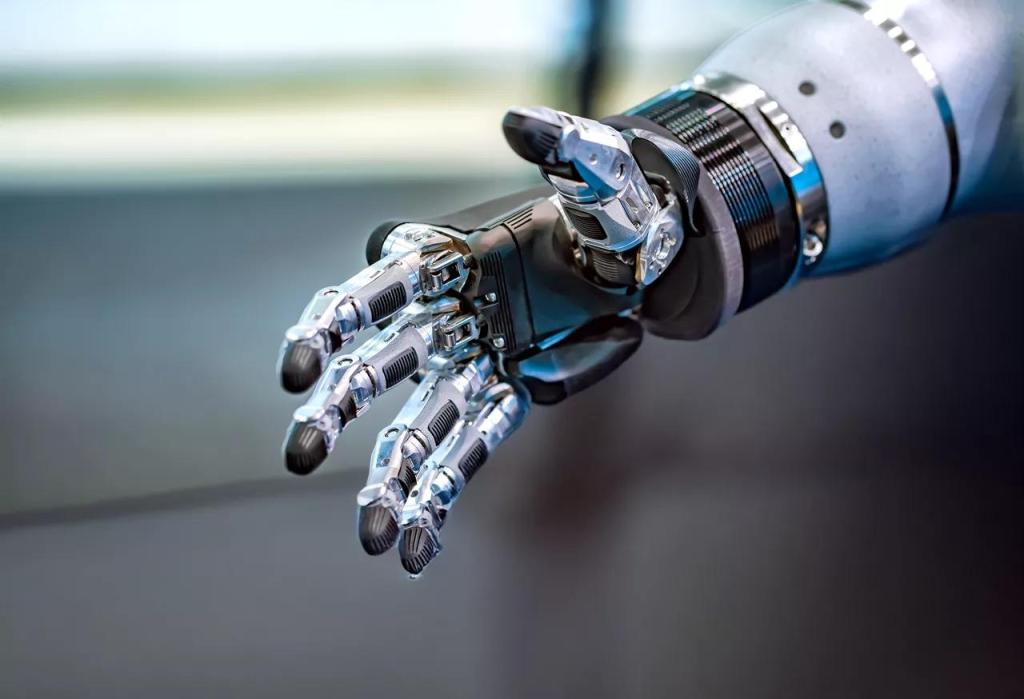
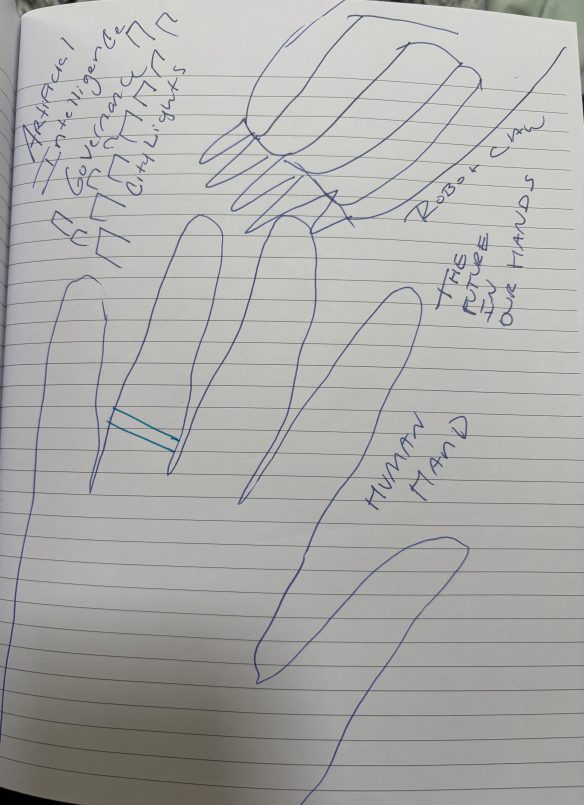
Concept #2 — Human and Robot Working Together
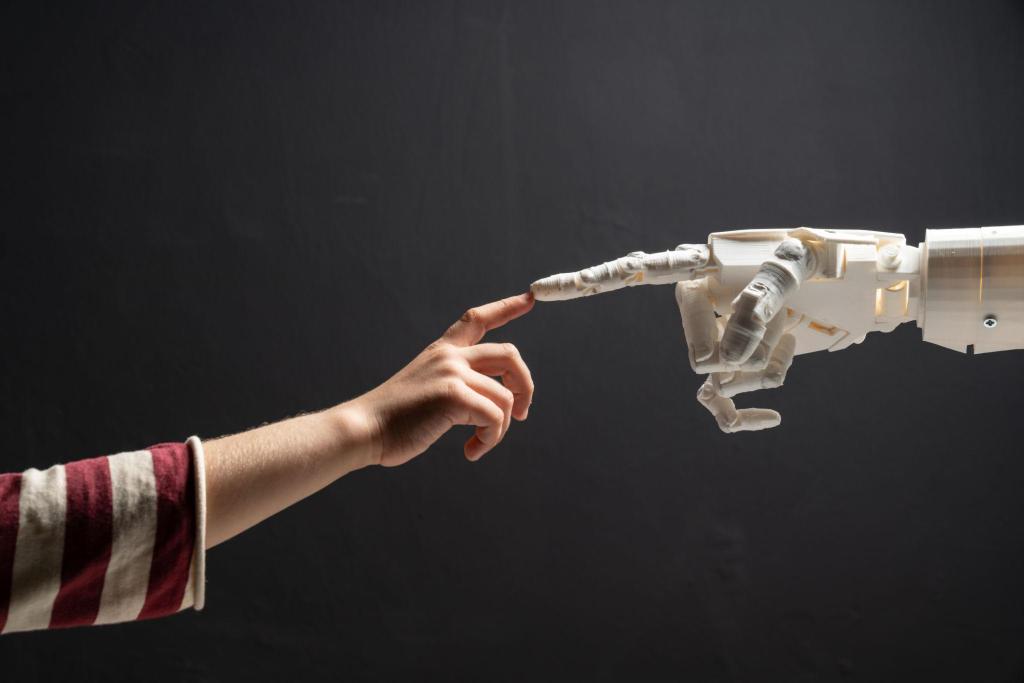
My second idea focused on two hands reaching toward each other. The human and robotic hands symbolized trust, cooperation, and the belief that AI should assist people rather than replace them.
Concept #3 — AI Supporting Zero Hunger
My third concept combined the earlier ideas with a specific humanitarian purpose: fighting hunger. It featured people, a globe, technology, and human cooperation, leading to the final campaign slogan, “AI Can Help. Humanity Must Lead.”
THREE HYPER-REALISM POSTER SKETCHES — ZERO HUNGER CAMPAIGN
Sketch #1 — Global AI Governance
This sketch explores worldwide cooperation and the ethical responsibility of humans to guide technology.
Sketch #2 — Human and Robot Working Together
This sketch emphasizes connection, collaboration, and a future where people and technology work together.
Sketch #3 — AI for Zero Hunger: Wealth Cannot Replace Food or Water
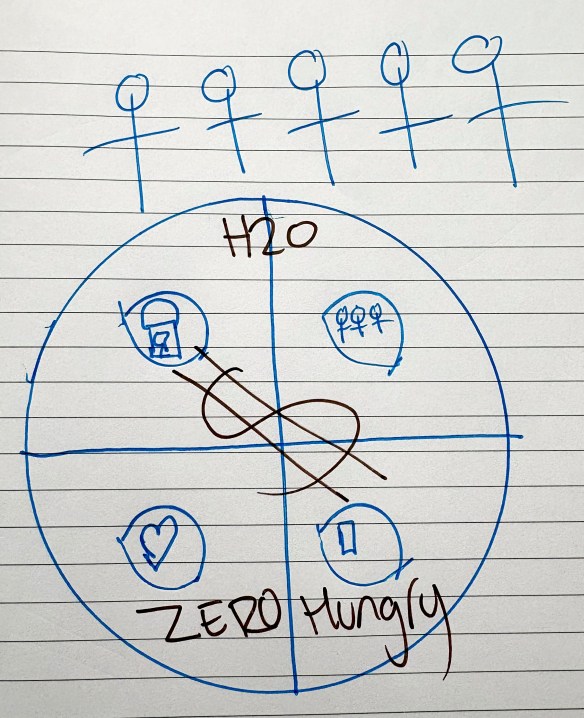
My third sketch challenges the way society values money over the basic necessities that sustain human life. The people at the top represent humanity, while the water, food, heart, and dollar sign symbolize survival, compassion, and the influence of wealth on our priorities. We live in a world where people chase money and measure success by financial status, yet no amount of money can replace the food that nourishes our bodies or the clean water that keeps us alive. I wanted this design to remind viewers that hunger is not simply about the absence of food, but also about unequal access, misplaced priorities, and our responsibility to care for one another. My message is simple: we cannot eat money or drink wealth, and true prosperity means creating a world where no one is denied the necessities of life.
ORIGINAL POSTER — BEFORE INSTRUCTOR FEEDBACK
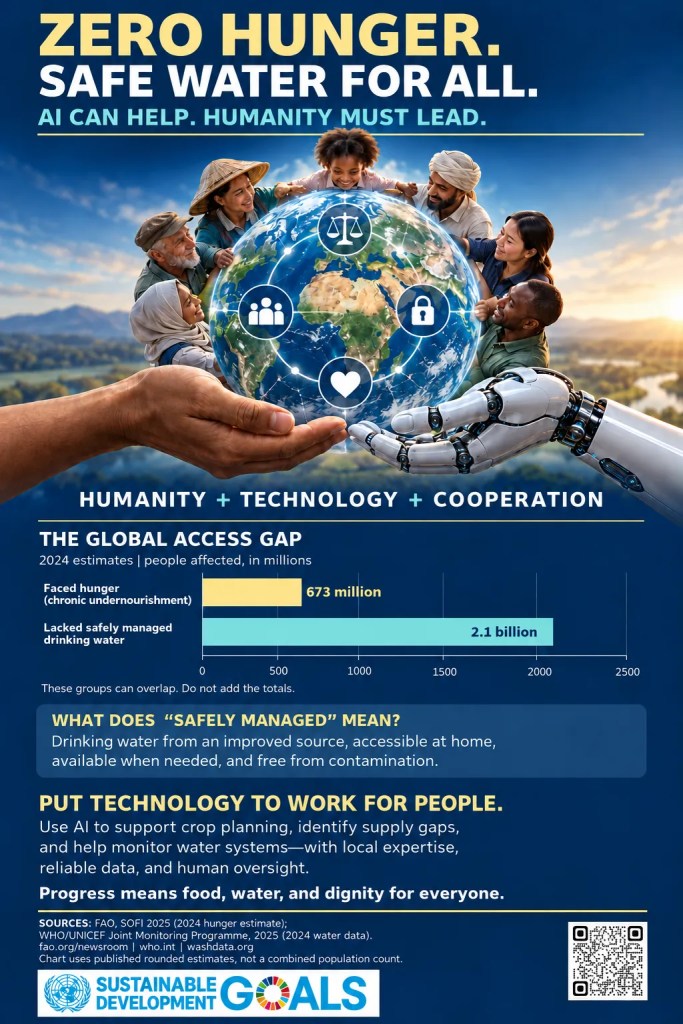
This sketch connects the earlier ideas to hunger, water, and human well-being.
FROM SKETCH TO FINAL POSTER
Professor Moreaux wanted the globe and the human and robotic hands to tell the story, rather than having the audience read a lot of text.
My original Zero Hunger poster brought together the globe, human and robotic hands, diverse communities, statistics, and descriptions to communicate the importance of fighting hunger through responsible technology. Professor Moreaux appreciated my concept, typography, color palette, and especially the symbolism of the two hands, but encouraged me to simplify the design by reducing the amount of text. His feedback helped me recognize that powerful imagery can communicate a meaningful message without overwhelming the viewer with information. I decided to make the globe and supporting hands the focal point, allowing them to tell the story of humanity and technology working together. My goal is for viewers to immediately understand the message, “AI Can Help. Humanity Must Lead,” and recognize that compassion and human responsibility must guide innovation.
FINAL POSTER — ZERO HUNGER: AI CAN HELP. HUMANITY MUST LEAD.
The Power of a Picture — The future should not be measured only by what our machines can accomplish, but also by the people we refuse to leave behind. No one should have to sacrifice dignity to survive.
We live in a world where artificial intelligence can predict the future of technology, machines can accomplish what once seemed impossible, and innovation continues to break barriers. Yet millions of people still struggle to access something as basic as a nutritious meal or clean drinking water. How can we call ourselves advanced when so many are still fighting simply to survive? I believe true progress is not measured by how intelligent our machines become, but by how compassionately we care for one another. No human being should have to sacrifice their dignity just to meet the basic necessities of life.
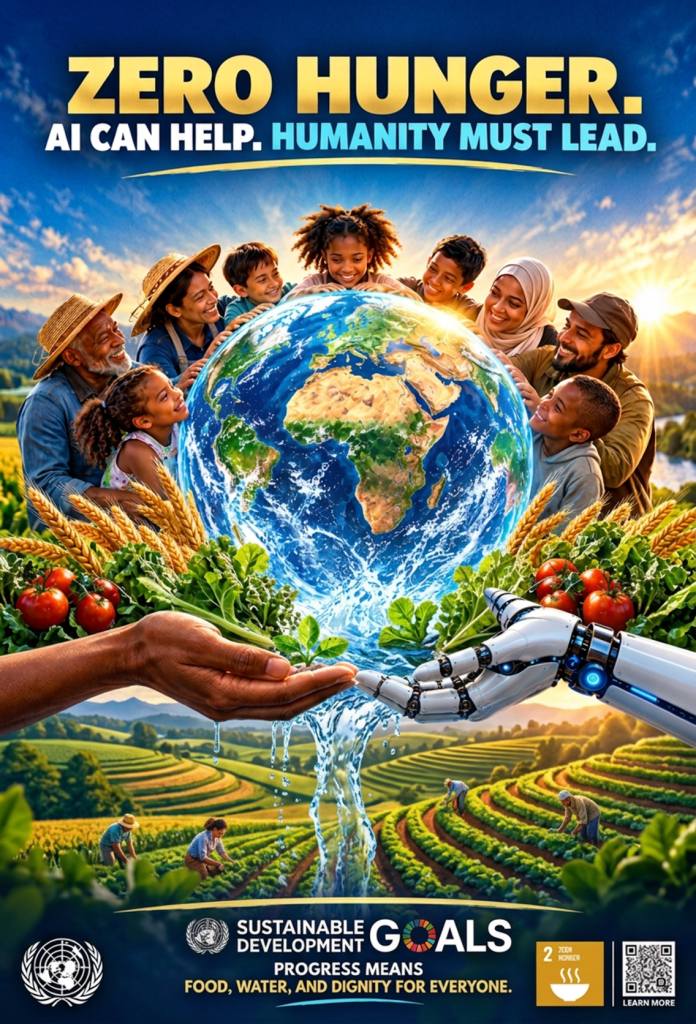
The greatest measure of progress is not how advanced our technology becomes, but how many people benefit from it.
Final Poster Reflection — Zero Hunger: AI Can Help. Humanity Must Lead.
The Power of a Picture, the Responsibility of Humanity
My original poster had enough words to deliver an entire lecture, but Professor Moreaux helped me recognize that sometimes the most powerful stories are the ones we allow an image to tell. By removing unnecessary text and bringing the globe and two supporting hands into focus, I discovered that visual storytelling is not about filling every available space, but about creating something meaningful enough to make people pause, reflect, and feel.
The human hand represents compassion, conscience, and our responsibility to one another, while the robotic hand symbolizes innovation and artificial intelligence’s potential to improve agriculture, strengthen food distribution, and help address global hunger. Together, they remind us that although technology can process information and identify solutions, it cannot replace the human responsibility to care, make ethical decisions, and protect those who are vulnerable.
I intentionally kept the diverse people surrounding the globe because hunger is not merely a number in a report; behind every statistic is a child, a family, and a community whose lives matter. Everyone deserves access to nutritious food, clean drinking water, and the dignity of knowing they haven’t been forgotten.
I consider my completed composition successful because the imagery now carries the message, while the typography and hopeful color palette support it without competing for attention. This project taught me that a picture may be worth a thousand words, but its greatest power lies in the compassion, awareness, and action it inspires. We live in a world increasingly shaped by artificial intelligence, yet our greatest responsibility remains profoundly human: progress should never be measured solely by what our machines can accomplish, but by how many lives we choose to uplift and how many people we refuse to leave behind.
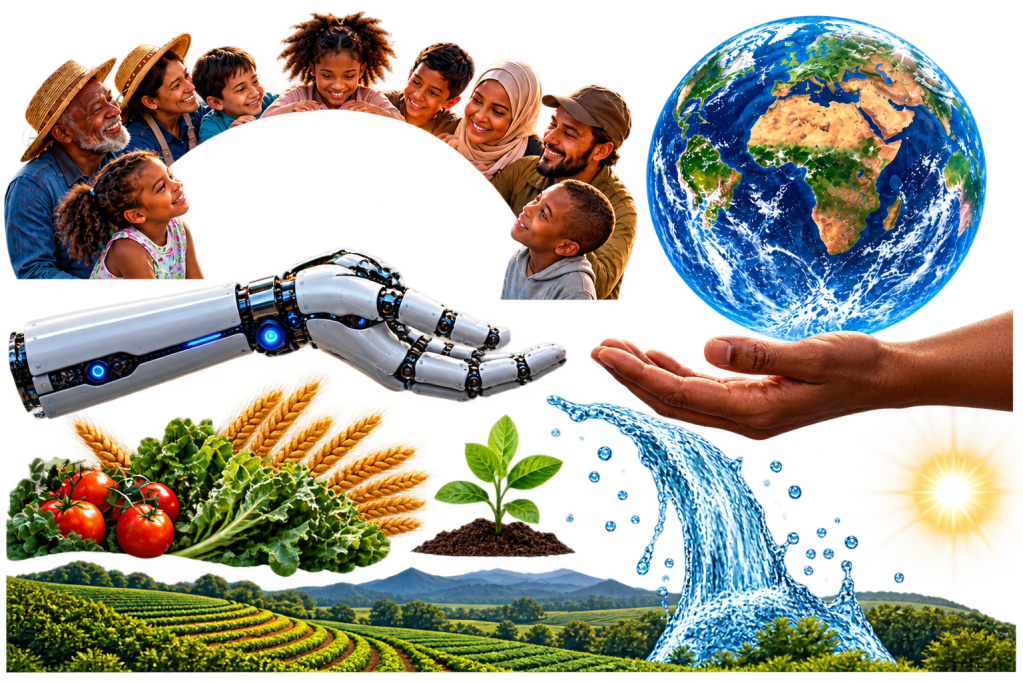
The Meaning Behind My Images — Zero Hunger Campaign
For my Zero Hunger campaign, “AI Can Help. Humanity Must Lead,” I carefully selected each visual element to represent something greater than what we see. My goal was to show how humanity, compassion, technology, and our natural resources are connected in the fight against global hunger.
The People — Humanity, Diversity, and Unity
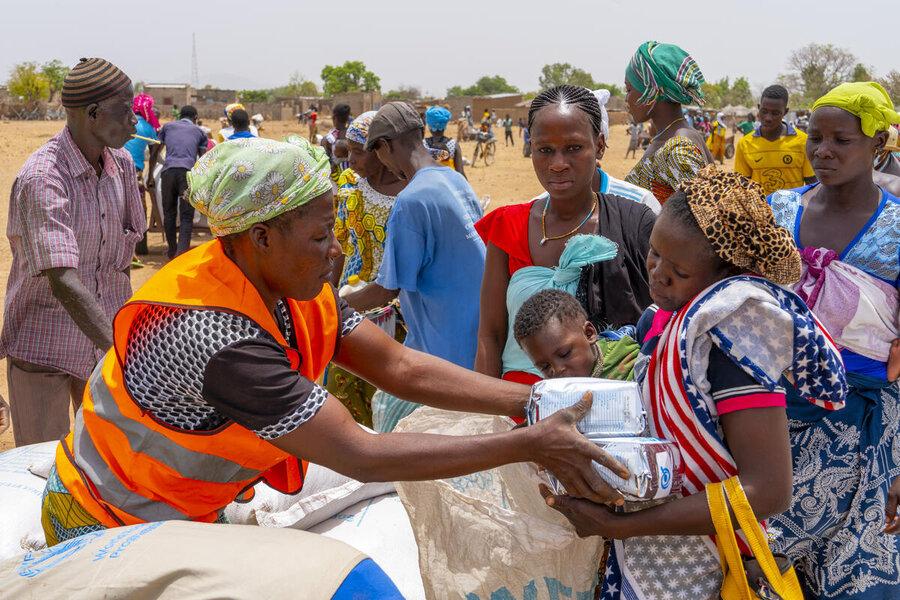
The people represent different cultures, generations, and communities around the world. I wanted to remind viewers that hunger does not discriminate and that behind every statistic is a real person, family, or child deserving of dignity and opportunity. Their presence symbolizes our shared humanity and the responsibility we have to care for one another.
The Globe — Our Shared Home and Responsibility
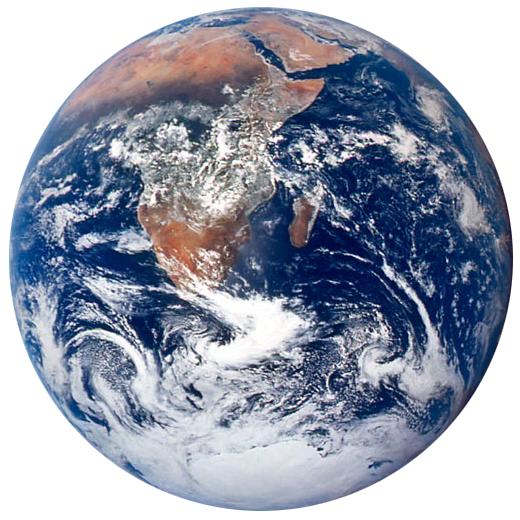
The globe represents Earth and reminds us that hunger, poverty, and water insecurity are global challenges. Regardless of our differences, we share one planet and depend on many of the same natural resources. I placed the globe at the center because protecting humanity and sustaining life should remain our greatest priorities.
The Human Hand — Compassion and Moral Responsibility
The human hand represents empathy, kindness, accountability, and our ability to make ethical decisions. It symbolizes the importance of reaching out to help others rather than ignoring their suffering. I wanted this hand to remind viewers that technology may offer solutions, but people must choose to act with compassion.
The Robotic Hand — Artificial Intelligence and Innovation
The robotic hand symbolizes artificial intelligence and the possibilities of technological advancement. AI can help improve agriculture, identify food shortages, manage resources, and support more efficient food distribution. However, I wanted to emphasize that technology should serve humanity rather than replace human judgment or responsibility.
The Two Hands Together — Cooperation Between Humanity and Technology
The human and robotic hands working together represent the central message of my campaign: “AI Can Help. Humanity Must Lead.” Their shared support of the Earth symbolizes the balance between technological innovation and human compassion. I believe the greatest achievements happen when intelligence, ethics, and responsibility work together for the benefit of everyone.
The Crops, Fruits, and Vegetables — Food Security and Nourishment
The wheat, fruits, and vegetables represent the nutritious food necessary for human survival. They symbolize agricultural abundance, food security, and the importance of ensuring that communities have access to healthy meals. I wanted to challenge viewers to recognize that producing food is not enough if people cannot afford or access it.
The Growing Seedling — Hope, Growth, and Future Generations
The small seedling represents new beginnings, sustainability, and the potential for positive change. Just as a seed needs water, sunlight, and care to grow, communities need resources, opportunities, and support to thrive. It also reminds me that the decisions we make today will shape the world future generations inherit.
The Flowing Water — Life, Health, and Survival
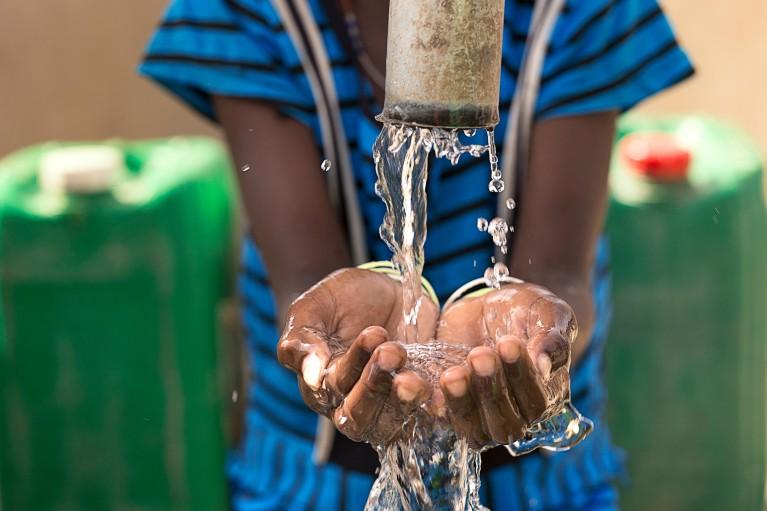
Water represents one of humanity’s most essential needs. I included flowing water because access to safe drinking water is directly connected to health, agriculture, and food security. It reminds viewers that clean water should never be considered a luxury when it is necessary for survival.
The Farmland — Agriculture, Sustainability, and Human Labor
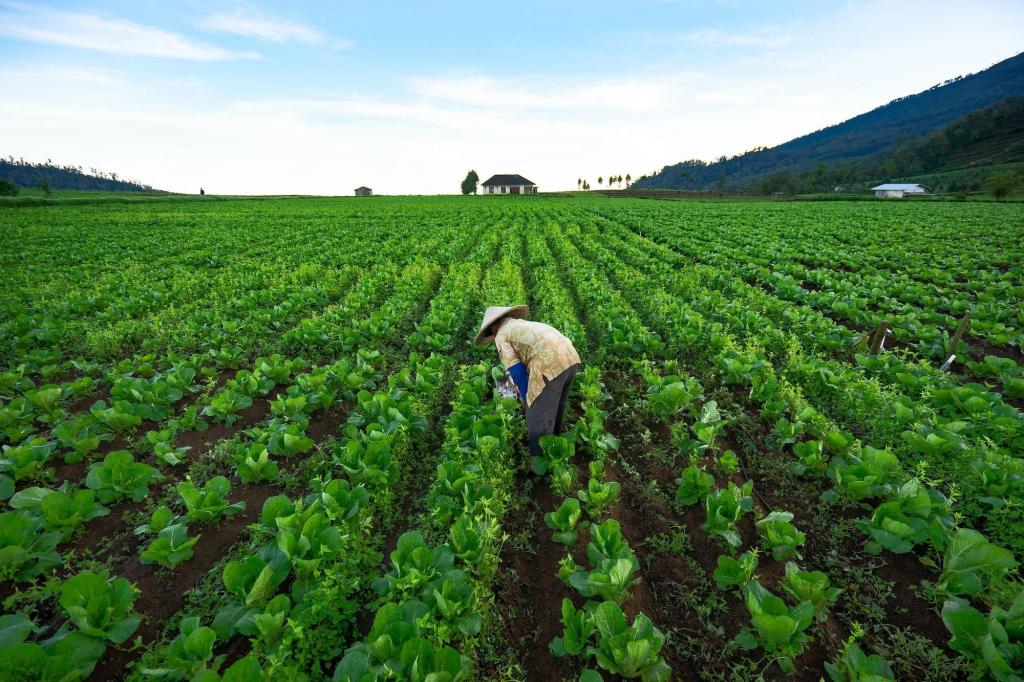
The farmland represents the foundation of our food systems and the people who work tirelessly to feed communities. It symbolizes sustainable agriculture, environmental responsibility, and the importance of protecting the land that provides our food. I wanted to recognize that farmers, agricultural workers, and healthy ecosystems are essential to achieving Zero Hunger.
The Sunlight — Hope, Renewal, and a Brighter Future
The sunlight represents hope, possibility, and the promise of a better tomorrow. Just as sunlight provides energy for crops to grow, compassion and cooperation can create opportunities for communities to flourish. I included it to communicate optimism and remind viewers that meaningful change is possible when we work together.
My Overall Message
Every element of my poster contributes to one larger story about what humanity truly needs to survive and thrive. We live in a world where people often measure success by money, power, and technological advancement, yet we cannot eat money or drink wealth. Food, clean water, healthy communities, and human dignity are more valuable than material possessions because they sustain life itself.
My poster challenges viewers to ask an important question: What is the purpose of advancing technology if we continue to leave people behind?
I believe true progress should never be measured only by how intelligent our machines become or how much wealth society accumulates, but by how many lives we improve, how many communities we strengthen, and how many people we refuse to forget.
AI can help us build a better world, but humanity must have the compassion, wisdom, and courage to lead it.
The Meaning Behind My Zero Hunger Poster
AI Can Help. Humanity Must Lead.
When I started creating my Zero Hunger poster, I knew I wanted it to be about more than just hunger. I wanted people to stop and think about the world we are living in. We have artificial intelligence, billion-dollar companies, advanced technology, and people spending millions on things they do not even need, yet there are still children going to bed hungry and families struggling to find clean drinking water. Something about that just does not sit right with me.
I believe art should make people feel something, but it should also make them question what they see. Every image I chose has a purpose, and together they tell a story about humanity, our priorities, and what really matters in life.
The People — Nobody Should Be Forgotten
I chose people from different backgrounds, cultures, and generations because hunger doesn’t care what color you are, where you come from, or how much money you have. When we hear about millions of people suffering from hunger, it’s easy to forget those numbers represent actual human beings. Somebody’s child, somebody’s mother, somebody’s father, somebody’s family. I wanted people to look at my poster and see humanity, not just statistics. Everybody deserves to eat, drink clean water, and live with dignity.
The Globe — We All Share This World
I placed the globe in the center because no matter how divided we become by race, religion, politics, or money, we still share one Earth. We may live in different countries and have different opportunities, but we all need the same basic things to survive. The globe reminds me that hunger isn’t just somebody else’s problem. It’s a human problem, and we all have some responsibility for the world we’re leaving behind.
The Human Hand — Compassion Has to Come First
The human hand represents something technology cannot replace: our responsibility to care about one another. We can have all the knowledge and resources in the world, but what good are they if we don’t have compassion? That hand represents kindness, accountability, love, and the willingness to help somebody who may never be able to do anything for us in return. To me, that’s what being human is really about.
The Robotic Hand — Technology Should Help People, Not Replace Humanity
I included the robotic hand because I believe artificial intelligence can do some amazing things. AI can help farmers grow food more efficiently, identify communities experiencing shortages, improve distribution systems, and help us find solutions to problems we’ve struggled with for generations. But just because technology can do something doesn’t mean we should stop thinking about the people affected by it. Machines can process information, but human beings are responsible for deciding how that information should be used. Technology should make life better for people, not make people less important.
The Two Hands Together — We Need Each Other
This is probably my favorite part of the entire composition because it represents the heart of my message. The human hand and robotic hand are both supporting the globe. Neither one is supposed to replace the other. I wanted to show what becomes possible when human compassion and technological innovation work together. AI might help us discover solutions, but humanity has to care enough to put those solutions into action. That’s why my slogan is “AI Can Help. Humanity Must Lead.”
The Food and Crops — We Cannot Eat Money
The wheat, fruits, and vegetables represent something we sometimes take for granted: food. We live in a world where people are constantly chasing money, status, expensive cars, and material possessions, but at the end of the day, we cannot eat money. It doesn’t matter how wealthy somebody becomes; their body still needs nourishment. What bothers me is knowing we have the ability to produce so much food while people are still going hungry. I wanted these images to challenge how we define wealth and remind people that having enough food to survive should never be considered a privilege.
The Seedling — Everything Starts Somewhere
The little plant represents hope and new beginnings. Something as small as a seed has the potential to grow into something that feeds an entire family, but it needs the right environment, water, sunlight, and care. I see people the same way. When communities are given resources, education, and opportunities, they have a better chance to grow and succeed. Sometimes making a difference starts with something small, but that doesn’t mean the impact has to be small.
The Water — We Cannot Drink Wealth
The flowing water represents life. Think about how many things we use water for every single day without even thinking twice about it. We drink it, cook with it, grow food with it, and depend on it to stay healthy. Yet there are communities where clean water is still difficult to access. We can build advanced machines, send people into space, and develop artificial intelligence, but what does all that progress mean if people are still struggling to get something as basic as safe drinking water? We cannot drink wealth, and nobody should have to fight for something necessary to stay alive.
The Farmland — Remember the People Who Feed Us
The farmland represents agriculture, hard work, and the foundation of our food supply. Sometimes I think we forget how much we depend on farmers and the people who grow and harvest our food. Technology can help improve agriculture, but we still need people, healthy soil, clean water, and an environment capable of sustaining life. I wanted to recognize the importance of protecting the resources we depend on instead of taking them for granted.
The Sunlight — There’s Still Hope
I included the sunlight because I didn’t want my poster to focus only on what’s wrong with the world. I wanted people to see hope, too. Every sunrise is another opportunity to make better decisions, help somebody, and do something meaningful. We may not be able to solve world hunger overnight, but that doesn’t mean we should stop trying. Change starts when people decide that somebody else’s suffering matters.
What I Really Want People to Understand
The more I worked on this project, the more I realized that my poster is not just about artificial intelligence or even hunger. It is about our values.
We live in a society where people will spend thousands of dollars on things they want while somebody else is struggling to afford what they need. We celebrate wealth, success, and technological breakthroughs, but how often do we celebrate making sure a child has a meal or a family has clean water?
I’m not saying money or technology is bad. We need resources, innovation, and financial stability. But I do believe we have to question our priorities when the things we’ve created become more important than the people we’re supposed to be helping.
Professor Moreaux’s feedback helped me understand that I didn’t need to put every thought I had into the poster itself. The images could tell the story. The globe, the people, the food, the water, and the two hands already communicate what I want people to understand.
We cannot eat money. We cannot drink wealth. And we cannot call ourselves truly advanced while forgetting the people who are struggling to survive.
If somebody looks at my poster and walks away thinking differently about how they treat people, how they value resources, or how technology could be used to help others, then I feel like I’ve accomplished something meaningful.
Because at the end of the day, I do not believe the greatest measure of progress is how much money we make or how intelligent our machines become.
I believe it is how we treat one another, how many lives we choose to uplift, and whether we are willing to make sure nobody gets left behind.
That is what Zero Hunger means to me.
AI Can Help. Humanity Must Lead.

