
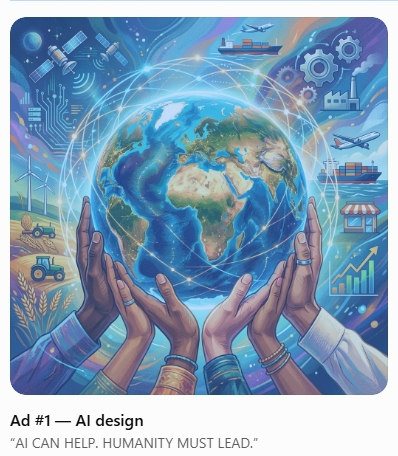
Campaign: Zero Hunger: AI Can Help. Humanity Must Lead.
Sustainable Development Goal: SDG 2 — Zero Hunger
Design Tools: AI image generation and Adobe Photoshop for further refinement.
Campaign Concept
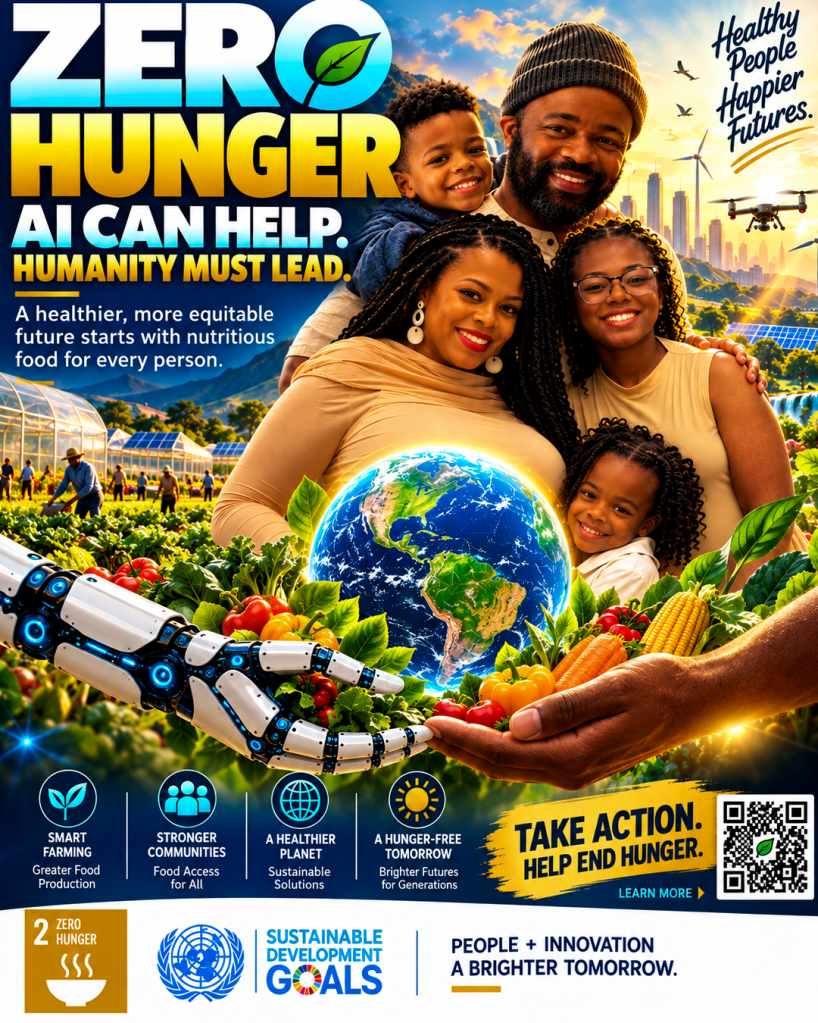
My Zero Hunger social media advertisement explores how artificial intelligence, sustainable agriculture, and human compassion can work together to create a future where everyone has access to nutritious food.
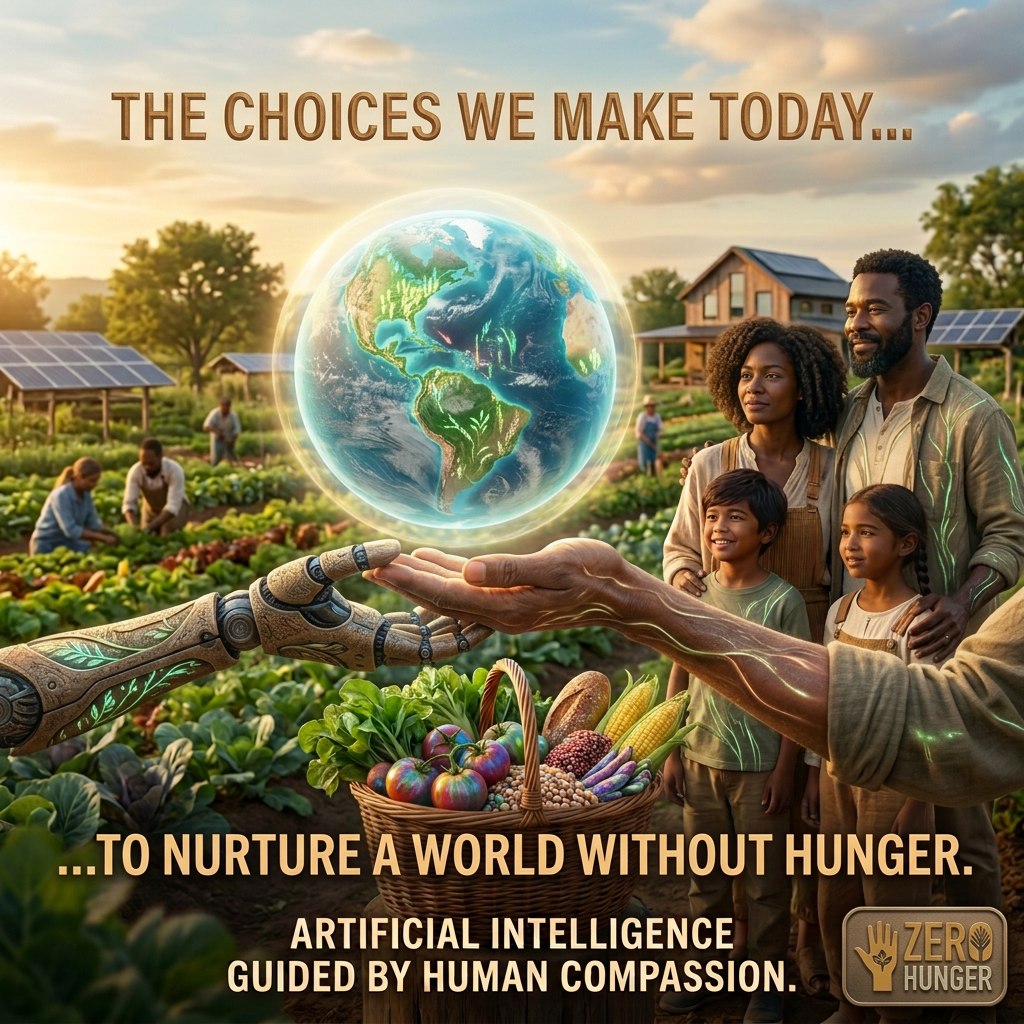
The family represents hope, unity, and the next generation. The glowing Earth symbolizes our shared responsibility, while the robotic and human hands represent collaboration between technology and humanity.
The agricultural imagery, renewable energy, and futuristic farming elements demonstrate how innovation can support sustainable food production.
Design Process and Inspiration
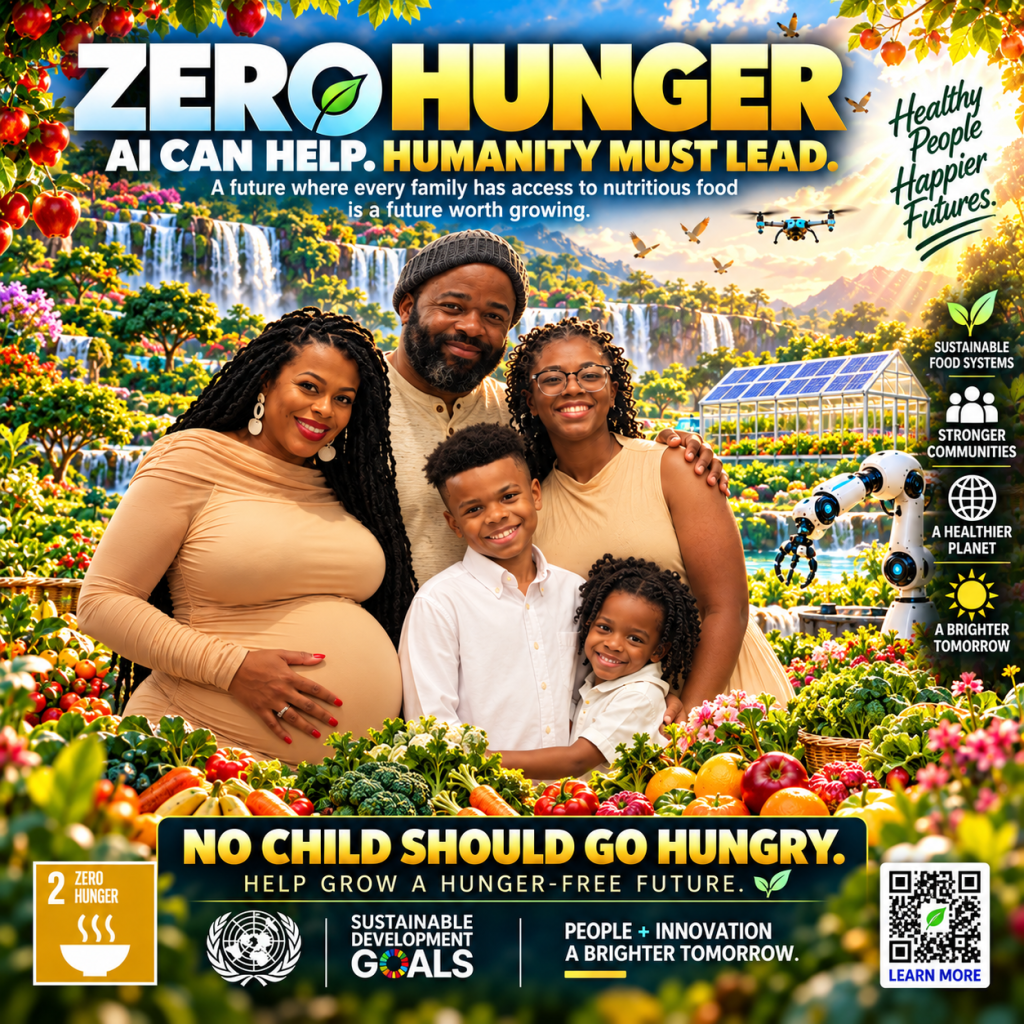
I developed this advertisement as an AI-generated iteration of my original Zero Hunger poster. I maintained the campaign’s navy blue, gold, aqua, and white color scheme to create a consistent visual identity. I used bold typography and a strong visual hierarchy to emphasize the message, “AI Can Help. Humanity Must Lead.” The family serves as the emotional focal point, helping viewers connect hunger to real people and future generations. The robotic and human hands symbolize the importance of combining technological innovation with human responsibility. I incorporated sustainable farming, renewable energy, and fresh produce to communicate the campaign’s environmental message. The United Nations Sustainable Development Goals branding reinforces the connection to SDG 2: Zero Hunger. I also included a call to action encouraging viewers to become part of the solution. For a future animated GIF, I plan to introduce subtle movement to the globe, agricultural imagery, and the campaign headline. My goal is to create a professional and visually consistent social media campaign that raises awareness and encourages meaningful action.
Campaign Message
ZERO HUNGER
AI CAN HELP. HUMANITY MUST LEAD.
Healthy People. Happier Futures.
Call to Action: Take Action. Help End Hunger.

ZERO HUNGER
AI Can Help. Humanity Must Lead.
Digital Media Marketing Campaign | Assignment #8
Campaign Theme: United Nations Sustainable Development Goal 2 — Zero Hunger
Creative Direction: Human-Centered Innovation, Sustainable Agriculture, Global Food Security, and Social Impact
1. Original Rough Draft — Campaign Vision and Creative Concept
My original rough draft was developed around one fundamental belief: the future of food security depends not only on how advanced our technology becomes, but also on how effectively humanity chooses to use it. Artificial intelligence has the potential to transform agricultural production, improve resource distribution, and support sustainable food systems. However, meaningful progress toward ending hunger also requires compassion, equitable access, responsible leadership, and global collaboration.
With this philosophy guiding my creative direction, I envisioned a compelling, future-focused advertisement that communicates both the urgency of food insecurity and the possibilities of human-centered innovation. Rather than relying on imagery that emphasizes suffering, I deliberately chose a hopeful visual narrative designed to inspire optimism, collective responsibility, and action.
At the heart of my composition is a diverse, multigenerational family representing love, connection, resilience, and the generations whose futures depend on the decisions we make today. Their expressions of happiness and togetherness reinforce a central truth: access to nutritious food is essential to human dignity, health, and opportunity.
The illuminated Earth serves as the symbolic foundation of the composition, representing our interconnected world and shared responsibility to protect its resources. Positioned prominently in the foreground, the human and robotic hands represent a partnership between technological intelligence and human compassion. This visual metaphor communicates that AI should empower humanity, not replace human judgment, responsibility, or leadership.
Surrounding these elements are thriving agricultural fields, fresh produce, renewable energy systems, and advanced farming technologies. Together, they illustrate a future in which innovation supports environmental sustainability, stronger communities, and more resilient food systems.
The original composition established the campaign’s central message:
ZERO HUNGER
AI CAN HELP. HUMANITY MUST LEAD.
This statement serves as both the campaign’s identity and its guiding principle: technology can accelerate solutions, but humanity must determine the purpose, priorities, and ethical direction of progress.
2. Rough Draft Storyline — The Future of Food Is in Our Hands
The visual storyline begins with a family standing together in a vibrant, flourishing environment where technology and nature coexist. Their presence establishes the emotional foundation of the campaign, reminding viewers that the issue of hunger is ultimately about people, families, communities, and future generations.
At the center of the composition, a luminous Earth represents a shared global future. Its illumination conveys possibility, connectivity, and hope, while also emphasizing that food insecurity is an international challenge requiring collective solutions.
In the foreground, a technologically advanced robotic hand extends toward a human hand, both supporting an abundance of fresh fruits and vegetables. This interaction is the defining visual metaphor of the campaign. The robotic hand symbolizes artificial intelligence, precision agriculture, and technological innovation. The human hand represents compassion, ethical responsibility, leadership, and the understanding that technological progress must serve human needs.
The surrounding environment expands this narrative through carefully selected imagery. Agricultural workers and productive farmland represent the human effort behind food production. Renewable energy systems communicate environmental responsibility, while modern infrastructure and agricultural technology suggest the possibilities of innovation-driven development.
Together, these elements create a visual progression from people, to possibility, to partnership, to action.
The campaign concludes with a direct and purposeful call to action:
TAKE ACTION. HELP END HUNGER.
From a strategic communications perspective, this storyline is designed to guide viewers through three stages: emotional connection, awareness of potential solutions, and motivation to become involved.
Rather than simply informing audiences that hunger exists, the campaign invites them to imagine a future in which sustainable solutions are possible and collective action can make a meaningful difference.
3. AI Prompt and Creative Development
After developing my original composition, I used artificial intelligence as a creative development tool to explore how professional advertising techniques could strengthen the campaign’s visual communication.
My original AI refinement prompt was:
“IMPROVE IMAGE LIKE PR FIRM FOR ZERO HUNGER CAMPAIGN USE PSYCHOLOGY”
Although concise, this prompt established a clear creative objective: elevate the existing design using the principles of professional public relations, advertising psychology, emotional engagement, and visual communication.
The original artwork served as the visual reference, allowing the AI-generated iteration to build upon the established campaign concept rather than introducing an unrelated design.
My intention was to explore how a public relations agency might approach the same creative challenge by prioritizing audience attention, emotional relevance, message clarity, brand recognition, and a compelling call to action.
Throughout this process, my creative direction remained centered on preserving the campaign’s human-centered message and visual consistency with the original Zero Hunger poster.
4. AI Design Revisions — Strategic Advertising and Visual Psychology
The AI-generated iteration provided an opportunity to evaluate how changes in visual hierarchy, composition, typography, and emotional presentation could strengthen the effectiveness of the advertisement.
Visual Hierarchy and Typography
One of my primary objectives was to establish a clear visual hierarchy that immediately communicates the campaign’s purpose. The enlarged “ZERO HUNGER” headline creates a dominant focal point, while the supporting statement, “AI CAN HELP. HUMANITY MUST LEAD,” reinforces the central message.
The use of bold, high-contrast typography is intended to improve recognition and readability, particularly on mobile devices where audiences often encounter advertisements while scrolling quickly.
Emotional Storytelling and Audience Connection
The family remains the emotional centerpiece of the advertisement. Their expressions of joy, security, and togetherness create a positive emotional association with the campaign’s vision.
This approach draws upon the principles of emotional advertising by encouraging viewers to connect the issue of food security with human experiences rather than viewing hunger only as an abstract global statistic.
The inclusion of children reinforces the importance of protecting future generations, while the family as a whole represents the universal need for nourishment, stability, and opportunity.
Color Psychology and Brand Identity
Color plays an important role in establishing the campaign’s emotional tone and visual identity.
Navy blue communicates trust, stability, and technological innovation. Gold introduces warmth, optimism, and a sense of possibility. Aqua suggests progress, connectivity, and environmental awareness, while green reinforces the themes of agriculture, sustainability, and growth. White provides visual contrast and improves the legibility of the typography and supporting information.
By maintaining these colors throughout the design, I aimed to create a recognizable visual identity that could extend across print advertising, social media graphics, animated content, and future promotional videos.
Composition, Grid Alignment, and Visual Balance
The revised composition places greater emphasis on the relationship between the family, illuminated Earth, and human and robotic hands.
These elements establish a visual pathway that guides the viewer’s attention from the headline to the central imagery and ultimately toward the campaign’s call to action.
The agricultural environment provides context and depth, while the placement of supporting text and visual elements helps organize the information into a more structured advertising layout.
This process reinforced the importance of balancing visual complexity with readability, particularly when adapting detailed poster artwork for smaller digital screens.
Persuasive Messaging and Call to Action
An effective social impact campaign must communicate both a meaningful message and a clear opportunity for engagement.
The revised advertisement introduces a prominent gold call-to-action banner featuring the statement:
TAKE ACTION. HELP END HUNGER.
The use of action-oriented language encourages audience participation, while the QR code provides a potential connection between the advertisement and additional educational or engagement resources.
The overall messaging is designed to communicate hope, shared responsibility, and the possibility of meaningful progress without minimizing the seriousness of global hunger.
Campaign Consistency and Brand Recognition
Throughout the revision process, I prioritized maintaining continuity with my original Zero Hunger poster.
The repeated use of the campaign slogan, recognizable color palette, prominent family imagery, agricultural themes, and Sustainable Development Goals branding creates a unified visual identity.
This consistency is essential to the development of an integrated marketing campaign in which individual advertisements are immediately recognizable as parts of the same creative concept.
5. Final AI-Generated Advertisement — Communicating the Campaign’s Four Pillars
The refined advertisement brings together the original creative vision and a more structured approach to digital advertising.
Its visual narrative communicates four interconnected priorities:
Smart Farming — Innovation for Sustainable Food Production
Artificial intelligence, precision agriculture, and emerging technologies can support more efficient agricultural practices, improve resource management, and help farmers respond to environmental challenges.
Stronger Communities — Food Access and Human Well-Being
Food security is not simply about producing more food. It also involves ensuring that individuals and communities have reliable access to safe, nutritious, and affordable food.
A Healthier Planet — Environmental Sustainability
Sustainable agriculture and responsible resource management are essential to protecting ecosystems and supporting long-term food production.
A Hunger-Free Tomorrow — Investing in Future Generations
The ultimate objective is to help create a future in which children and families have greater opportunities to thrive without the barriers associated with hunger and food insecurity.
The supporting statement, “Healthy People. Happier Futures.”, connects these priorities to the broader relationship between nutrition, well-being, and sustainable development.
Together, these four pillars transform the advertisement from a single awareness graphic into the foundation of a coordinated social impact marketing campaign.
6. Future Animated GIF — Extending the Visual Story
For the next stage of the campaign, I envision transforming the static advertisement into a short animated GIF that uses movement to reinforce the central message without overwhelming the viewer.
The animation would open with a softly illuminated Earth, gradually revealing the agricultural landscape and sustainable farming environment. The human and robotic hands would then move toward one another, symbolizing the partnership between technological innovation and human responsibility.
As the composition develops, the family would remain the emotional focal point, reinforcing the connection between global food systems and human well-being.
The headline “ZERO HUNGER” would appear prominently, followed by the supporting statement, “AI CAN HELP. HUMANITY MUST LEAD.”
The animation would conclude with the campaign’s call to action:
TAKE ACTION. HELP END HUNGER.
Subtle transitions, controlled movement, and consistent typography would help maintain a professional visual identity. The goal is to attract attention, communicate the message quickly, and encourage viewers to seek more information.
7. Reflection — Design, Technology, and Human Responsibility
Developing this Zero Hunger campaign has strengthened my understanding of how visual communication, digital media marketing, advertising psychology, and artificial intelligence can work together to support a meaningful social objective.
The comparison between my original rough draft and the AI-generated iteration demonstrated that effective design is not determined solely by visual attractiveness. Successful communication requires a clear objective, an understanding of the intended audience, purposeful composition, readable typography, and a consistent visual identity.
I also gained a greater appreciation for the importance of emotional storytelling. By positioning the family at the center of the advertisement, I was able to connect the broader issue of global food insecurity with the everyday human experiences of health, security, and opportunity.
The AI-assisted revision process further demonstrated that artificial intelligence can be a valuable creative resource when guided by intentional human decision-making. However, the designer remains responsible for evaluating the accuracy, appropriateness, accessibility, and effectiveness of the final composition.
Ultimately, this project reflects more than the development of a social media advertisement. It represents my belief that innovation should be measured not only by what technology can accomplish, but also by how effectively it improves human lives.
“From My Sister’s Womb to the World”

Featured Family — The Heart Behind My Zero Hunger Campaign
From My Sister’s Womb to the World: Where My Inspiration Began
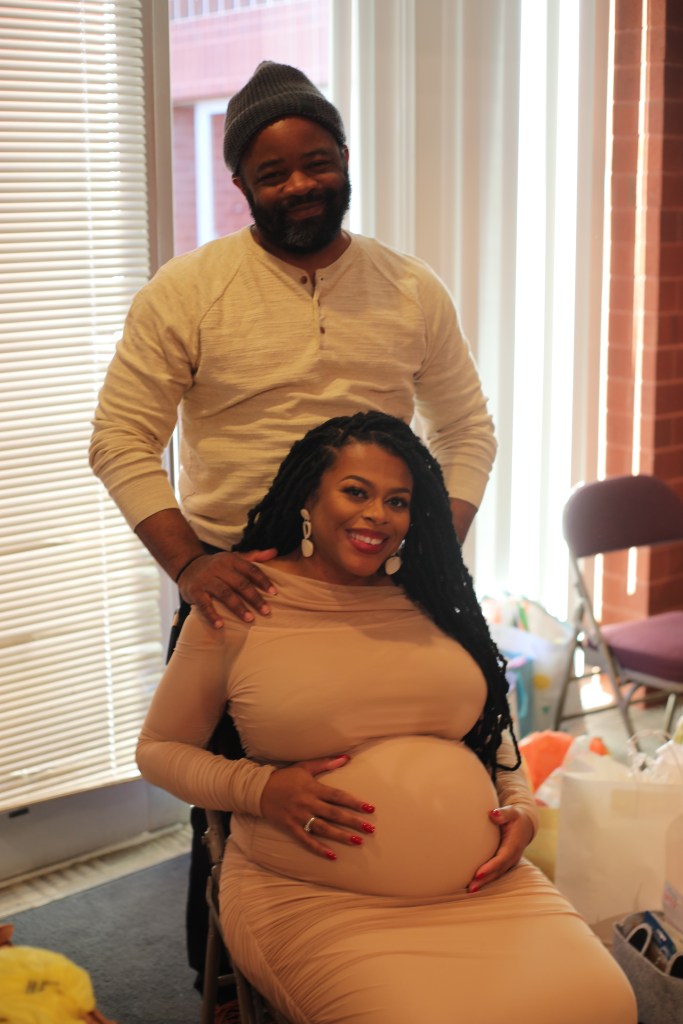
Every great idea begins with something that makes us see the world differently. For me, that moment came when I looked at my pregnant sister.
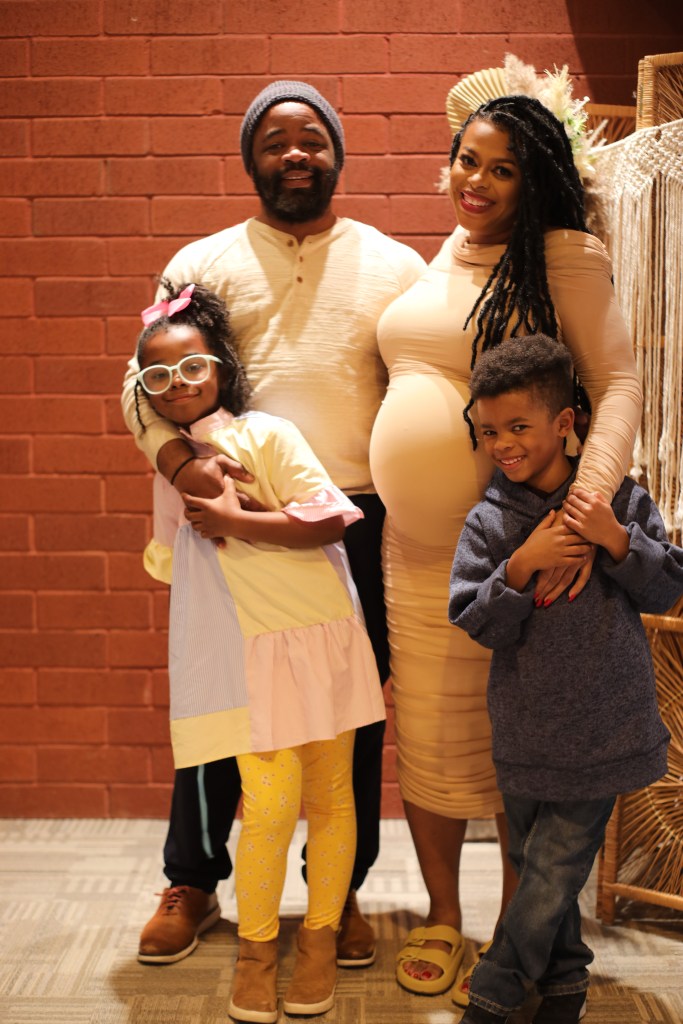
When I saw my sister, Dr. Dana Marshall, carrying new life in her womb, I kept noticing how the beautiful, round shape of her pregnant belly reminded me of the Earth. The more I thought about it, the more meaningful that connection became.
I began to see two powerful symbols of life: a mother’s womb nurturing a child and the Earth nurturing humanity.
Both represent growth, nourishment, protection, and the extraordinary responsibility of sustaining life.
That realization became one of the most meaningful inspirations behind my Zero Hunger campaign.
Women are co-creators of life. Through pregnancy and childbirth, they participate in the extraordinary process of bringing future generations into the world. A mother’s body provides nourishment and protection as new life develops, just as the Earth provides the natural resources necessary to sustain the people who inhabit it.
I wanted to capture that connection visually.
The glowing globe in my advertisement represents more than our planet. To me, it also symbolizes a mother’s womb: a place where life is nurtured, where growth begins, and where the future is being formed.
Just as a mother nourishes the life growing within her, humanity has a responsibility to nourish the lives growing upon the Earth.
This symbolism helped me recognize that food security is not simply an agricultural or technological issue. It is also about motherhood, childhood, family, community, and our responsibility to protect future generations.
My Family — The Inspiration Behind the Vision
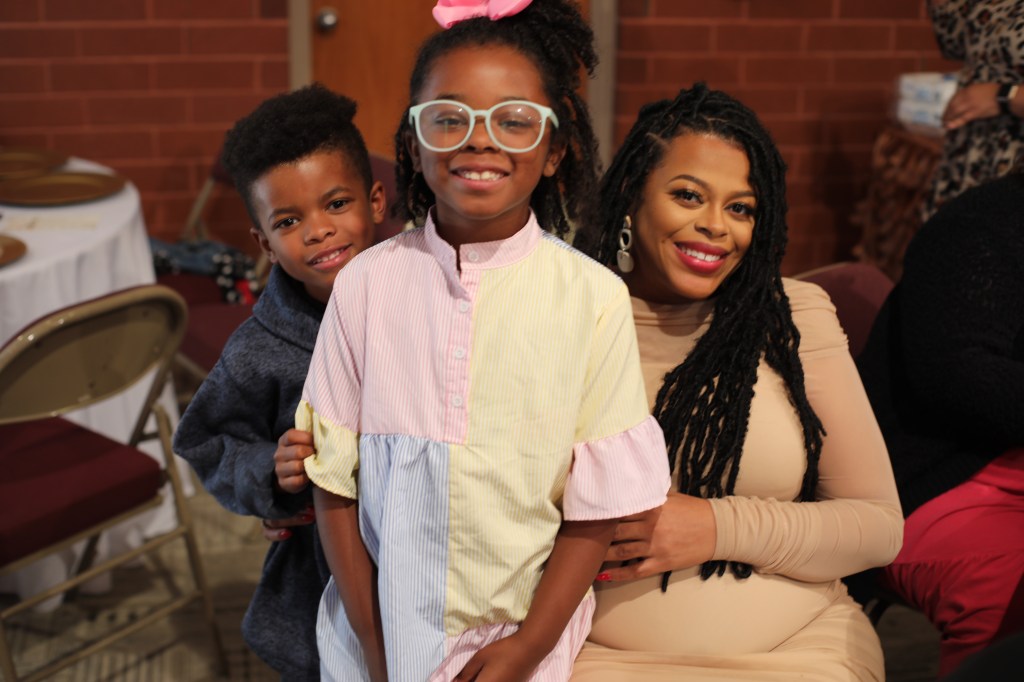
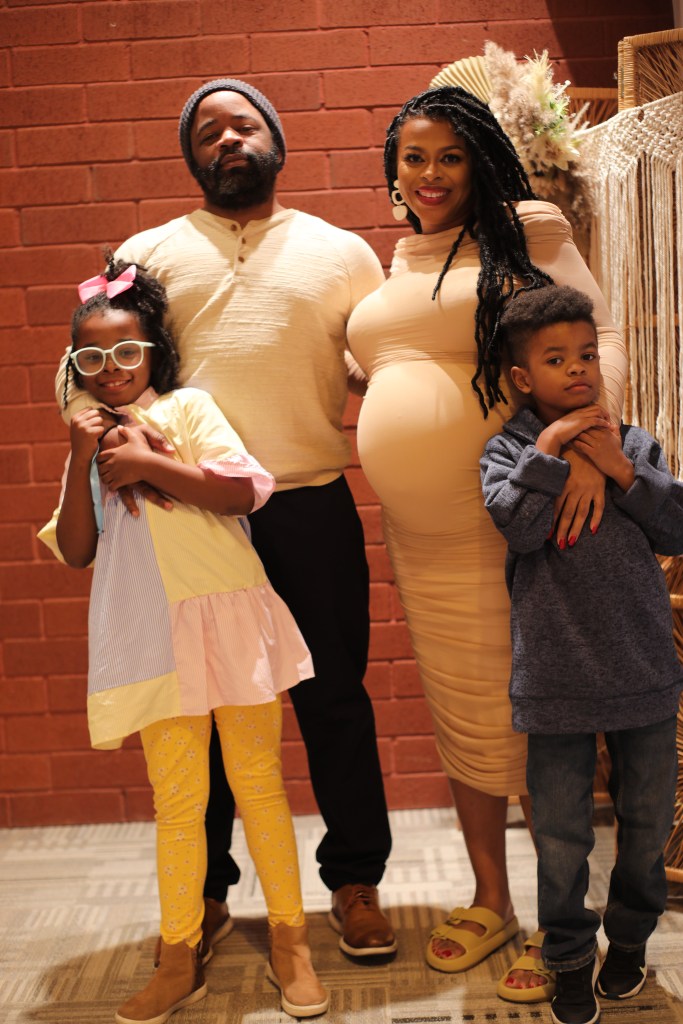
At the center of my campaign is my sister, Dr. Dana Marshall, her husband, Justin Marshall, and their three children, Emory, Paxton, and Anderson James.
Their presence makes this campaign personal because they represent the very future I want to protect.
When I think about my nieces and nephews, I think about all the children around the world who deserve the same opportunity to grow, learn, play, and dream without the uncertainty of hunger.
I deliberately chose joyful family imagery because I wanted people to see what we are working toward, not simply what we are fighting against.
Healthy children. Nourished families. Strong communities. A sustainable future.
Bringing Back Family Gardens — Growing Food, Growing Hope
Another important part of my inspiration is the belief that family gardens can once again become a meaningful part of how communities address hunger.
For generations, families have grown fruits, vegetables, and herbs in their backyards, shared land, and community gardens. These spaces have provided fresh food while passing valuable agricultural knowledge from parents and grandparents to children.
I believe we should encourage a renewed appreciation for these traditions.
Family gardens can help supplement household food supplies, improve access to fresh produce, teach children where their food comes from, and encourage healthier eating habits.
They can also bring families together.
Imagine parents teaching their children how to plant seeds, care for vegetables, conserve water, and harvest the food they helped grow. These experiences do more than produce food. They cultivate patience, responsibility, independence, and respect for the environment.
Community gardens can extend those benefits by creating shared spaces where neighbors exchange knowledge, support one another, and strengthen local food systems.
Gardens alone cannot eliminate global hunger. Large-scale solutions must also address poverty, food distribution, affordability, agricultural infrastructure, and unequal access to resources. However, family and community gardens can be valuable parts of a broader strategy for building food security.
Where Nature, Family, and Artificial Intelligence Meet
My campaign also explores how traditional agricultural knowledge and modern technology can work together.
Artificial intelligence can help farmers analyze growing conditions, monitor soil health, improve irrigation, and make more informed decisions about crop production.
These technologies could also support community-based agriculture as they become more accessible.
In my artwork, the human and robotic hands represent this partnership.
The human hand symbolizes care, wisdom, family traditions, and responsibility. The robotic hand symbolizes innovation and the tools that may help us grow food more sustainably.
The fresh produce between them represents what becomes possible when technology supports human needs.
The future of food security does not require us to abandon the wisdom of the past. It challenges us to combine that wisdom with the possibilities of the future.
My Deeper Message — Life Must Be Nurtured
The connection between my sister’s pregnancy and the globe changed the way I approached this project.
I began with an image of a family and developed a larger message about the relationship between humanity and the Earth.
A mother nurtures life within her body. Families nurture children through love and care. Gardens nurture seeds until they become food. The Earth provides the resources upon which all these processes depend.
Each reflects the same essential principle:
Life flourishes when it is nurtured.
My Zero Hunger campaign is ultimately a celebration of that principle.
It honors the women who bring life into the world, the families who raise future generations, the farmers who grow our food, and the communities working to ensure that everyone has enough to eat.
Most importantly, it reminds us that the future is something we must care for together.
From a mother’s womb to the world we share, every life deserves to be nourished.
ZERO HUNGER — THE FUTURE WE GROW TOGETHER
AI CAN HELP. HUMANITY MUST LEAD.
Healthy People. Happier Futures.
TAKE ACTION. HELP END HUNGER.

Social Media Advertisement #2 — The Future We Grow Together
Creative Concept: From the Garden of Eden to the Future of Farming
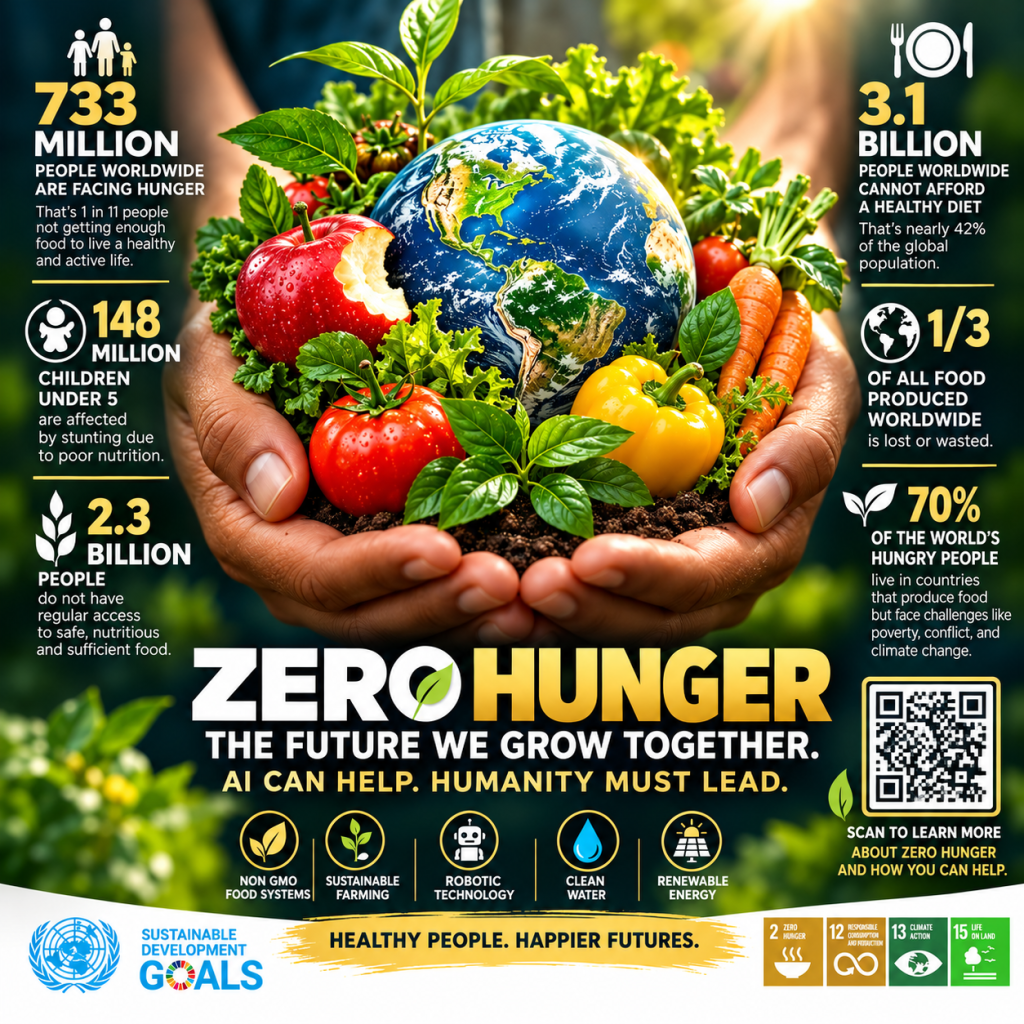
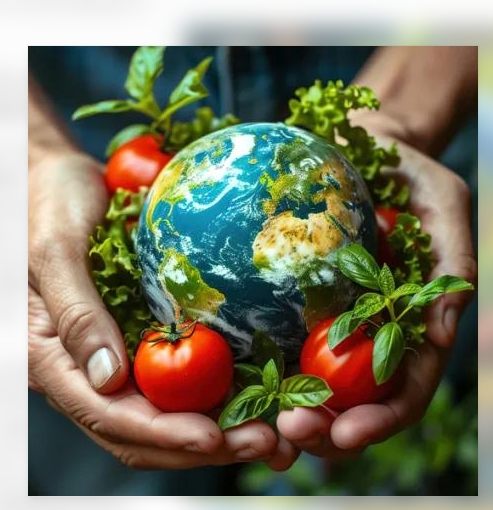
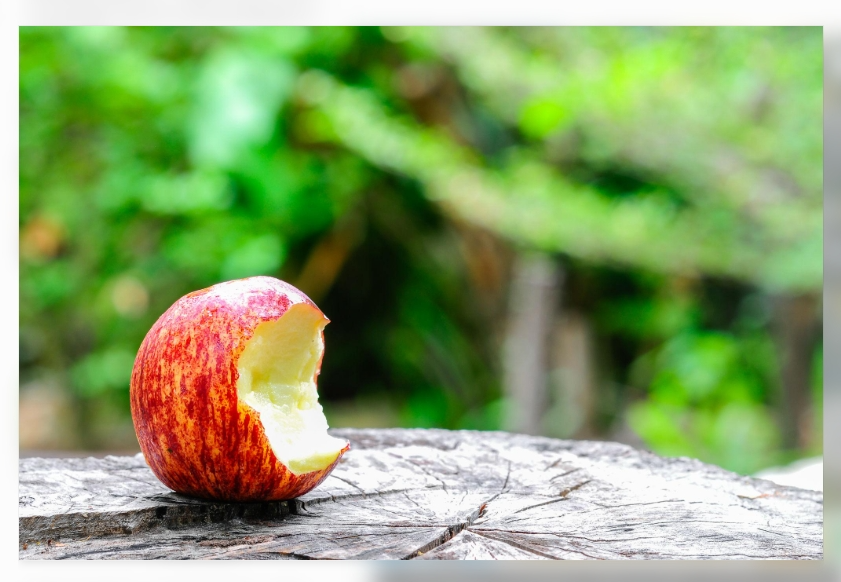
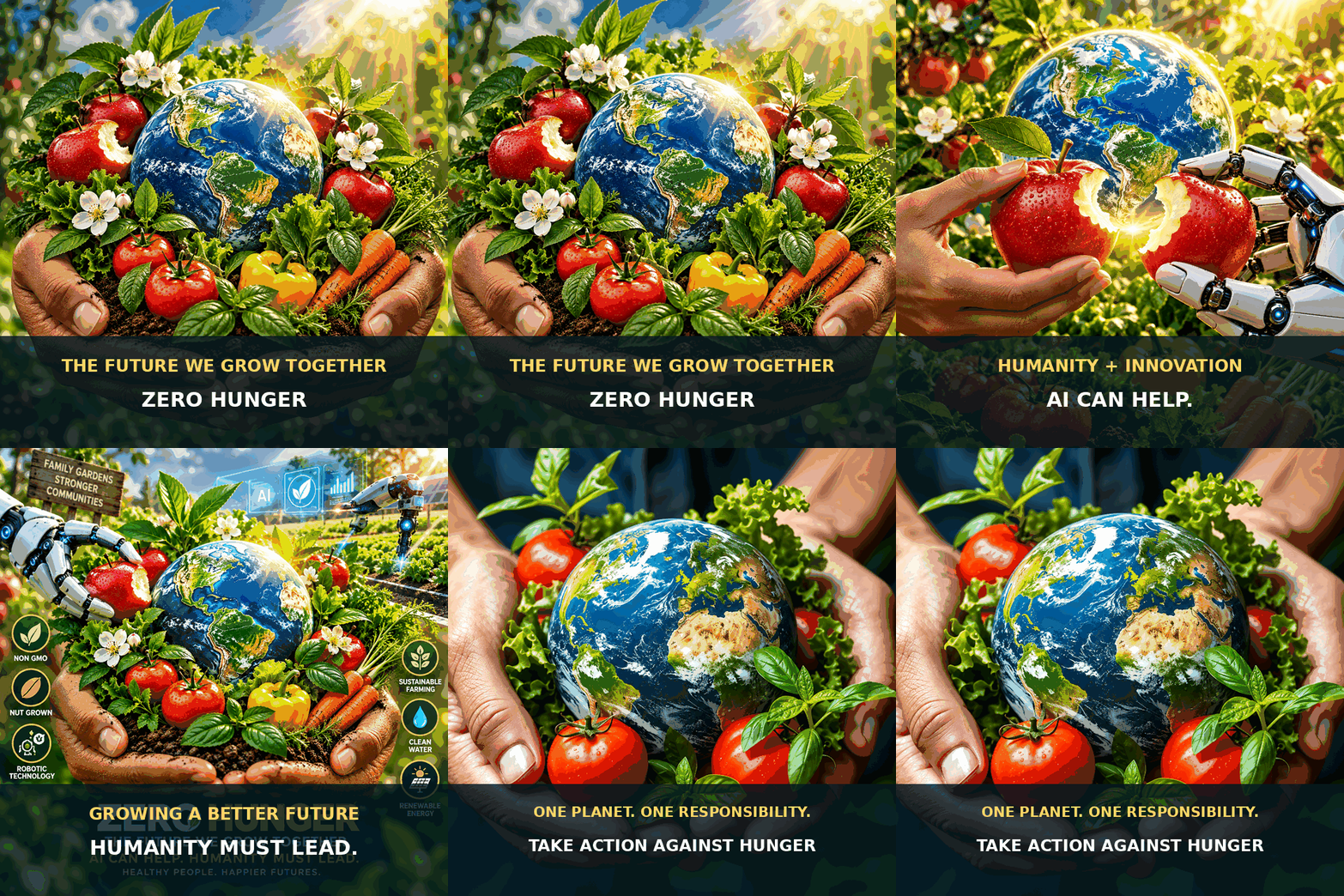
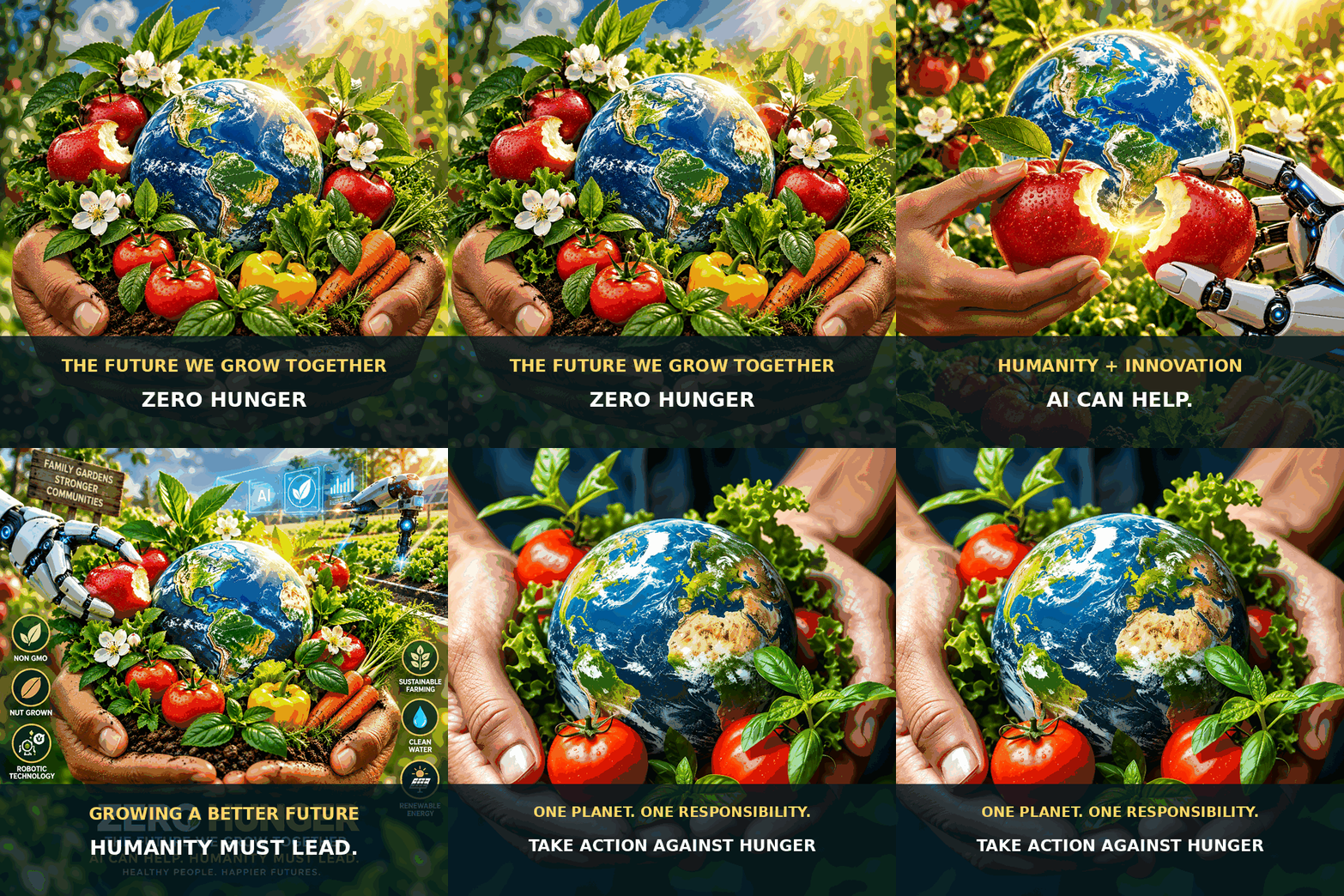
My second Zero Hunger advertisement was inspired by the Garden of Eden, where I imagined the Earth as a beautiful, abundant garden capable of nourishing humanity. I incorporated fresh apples, vegetables, flourishing plants, and rich soil to symbolize life, growth, and the importance of returning to family and community gardening. The bitten apple represents the choices humanity makes and our shared responsibility to care for the Earth and its resources.
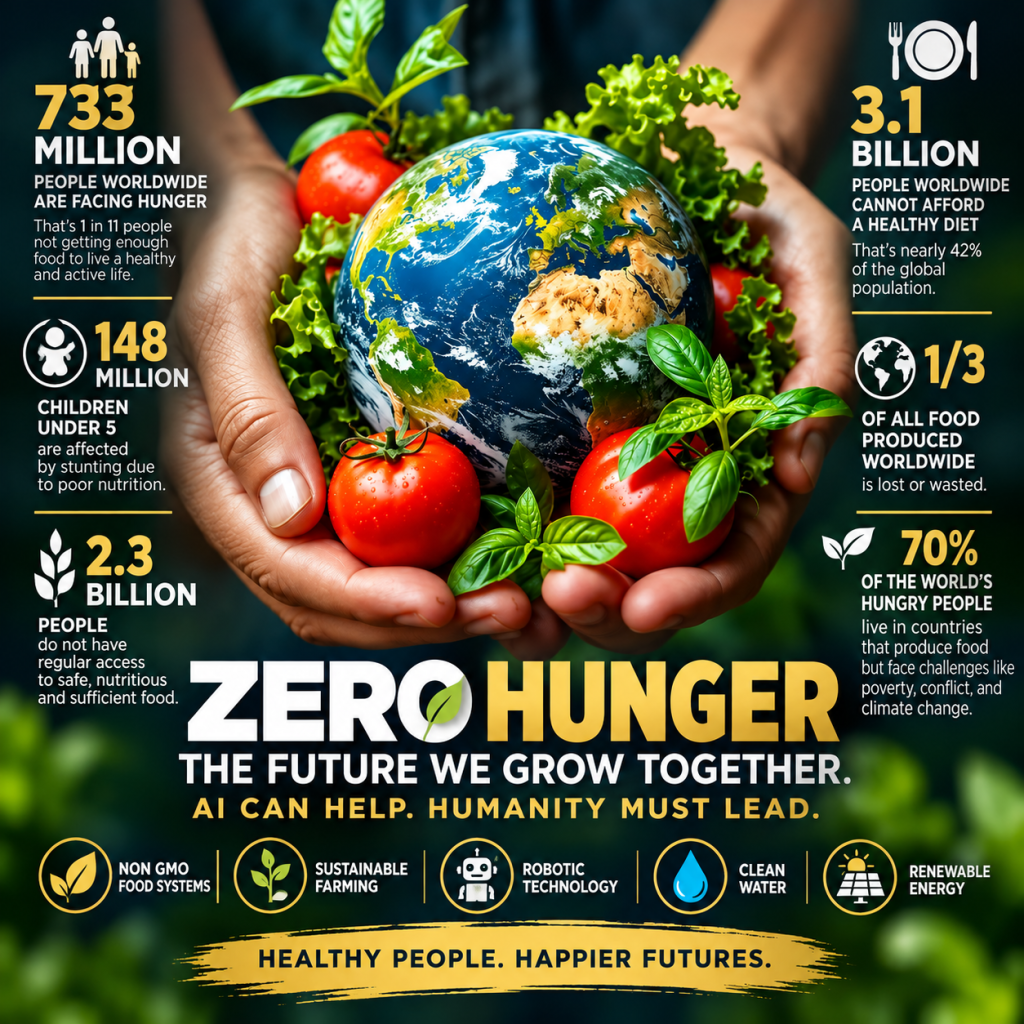
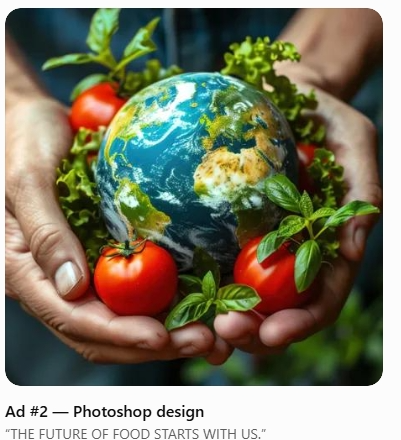
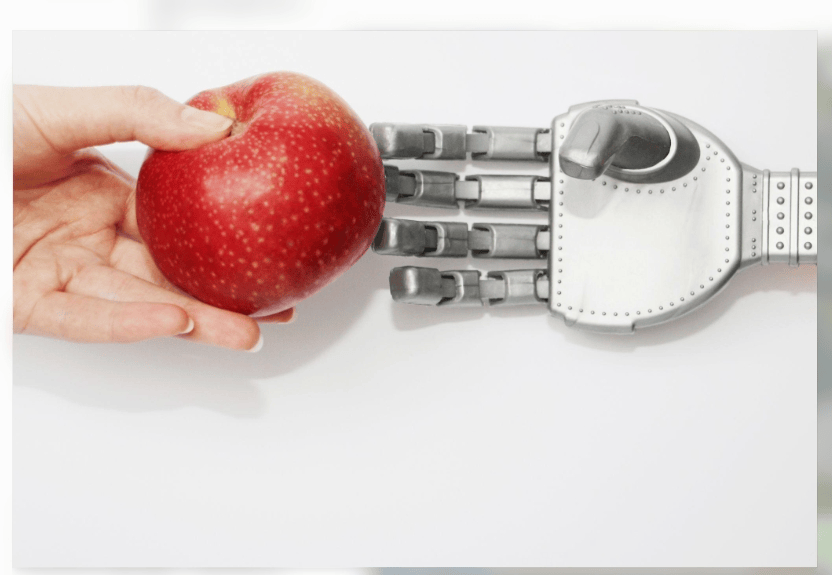
The human hands holding the globe represent compassion, stewardship, and the generations who depend on a healthy planet. The robotic hands and futuristic agricultural technology introduce the possibilities of artificial intelligence, including precision farming, water conservation, and improved crop management. I wanted to demonstrate that traditional gardening and advanced technology do not have to compete; they can work together to support a more sustainable future.
The design also highlights my interest in non-GMO gardening, clean water, renewable energy, and responsible agricultural practices. These ideas represent the type of food system I want to promote, rather than verified claims about the produce pictured.
To maintain consistency with my original Zero Hunger poster, I continued using the same navy blue, gold, aqua, white, and green color palette, bold Arial-inspired typography, glowing Earth imagery, and human-centered storytelling. The AI-assisted refinement helped me explore stronger lighting, composition, and visual hierarchy while preserving the original campaign message.
Ultimately, this advertisement communicates my belief that ending hunger requires more than technological advancement. It requires families, farmers, communities, and innovators working together to make nutritious food more accessible.
ZERO HUNGER — THE FUTURE WE GROW TOGETHER.
AI CAN HELP. HUMANITY MUST LEAD.
Week 8–9: Zero Hunger Social Media Campaign — Bringing the Vision to Life
Campaign Theme: The Future We Grow Together
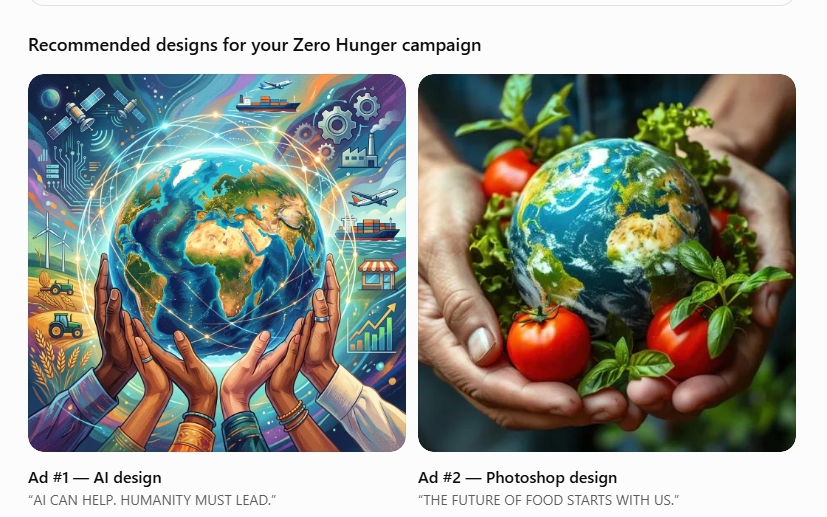
My social media campaign expands the message of my original Zero Hunger poster by connecting three powerful ideas: family, the Earth, and the future of food. Each advertisement tells a different part of the same story while maintaining a consistent visual identity through color, typography, imagery, and messaging.
My first advertisement focuses on families and children, reminding viewers that access to nutritious food is essential to healthy development and future generations. My second advertisement draws inspiration from the Garden of Eden, using apples, fresh produce, and the Earth to symbolize nourishment, responsibility, and the importance of growing food within our communities.
I also introduced robotic technology and artificial intelligence to explore how innovation can support traditional farming through smarter irrigation, improved crop management, and sustainable agricultural practices. The human hands represent compassion and responsibility, while the robotic elements represent the possibilities of technology working alongside humanity.
The global hunger statistics add urgency to the campaign by connecting the visual storytelling to the real challenges millions of people face. My goal is to create advertisements that do more than attract attention. I want viewers to think about food security, appreciate the resources we have, and consider how they can contribute to meaningful change.
Throughout this design process, I am experimenting with Photoshop composition, AI-assisted visual iterations, typography, animation, and social media storytelling. My next step is to transform these static designs into an animated GIF that connects the campaign’s major themes.
One Planet. One Humanity. One Shared Responsibility.
ZERO HUNGER — THE FUTURE WE GROW TOGETHER.
AI CAN HELP. HUMANITY MUST LEAD.
“Animated GIF #2 — The Future We Grow Together.”

